Quiet Commotion
Street Dance, Hip Hop, and Social Change in Tehran
by Brendan P. Behan, MFA
a.k.a., Breandán P. Ó Beacháin
Revised and updated version: December 17, 2025.
A prior version of this paper was first presented at Joint Conference of the Congress on Research in Dance and the Society for Dance History Scholars at Pomona College, Claremont, California, on November 6, 2016.
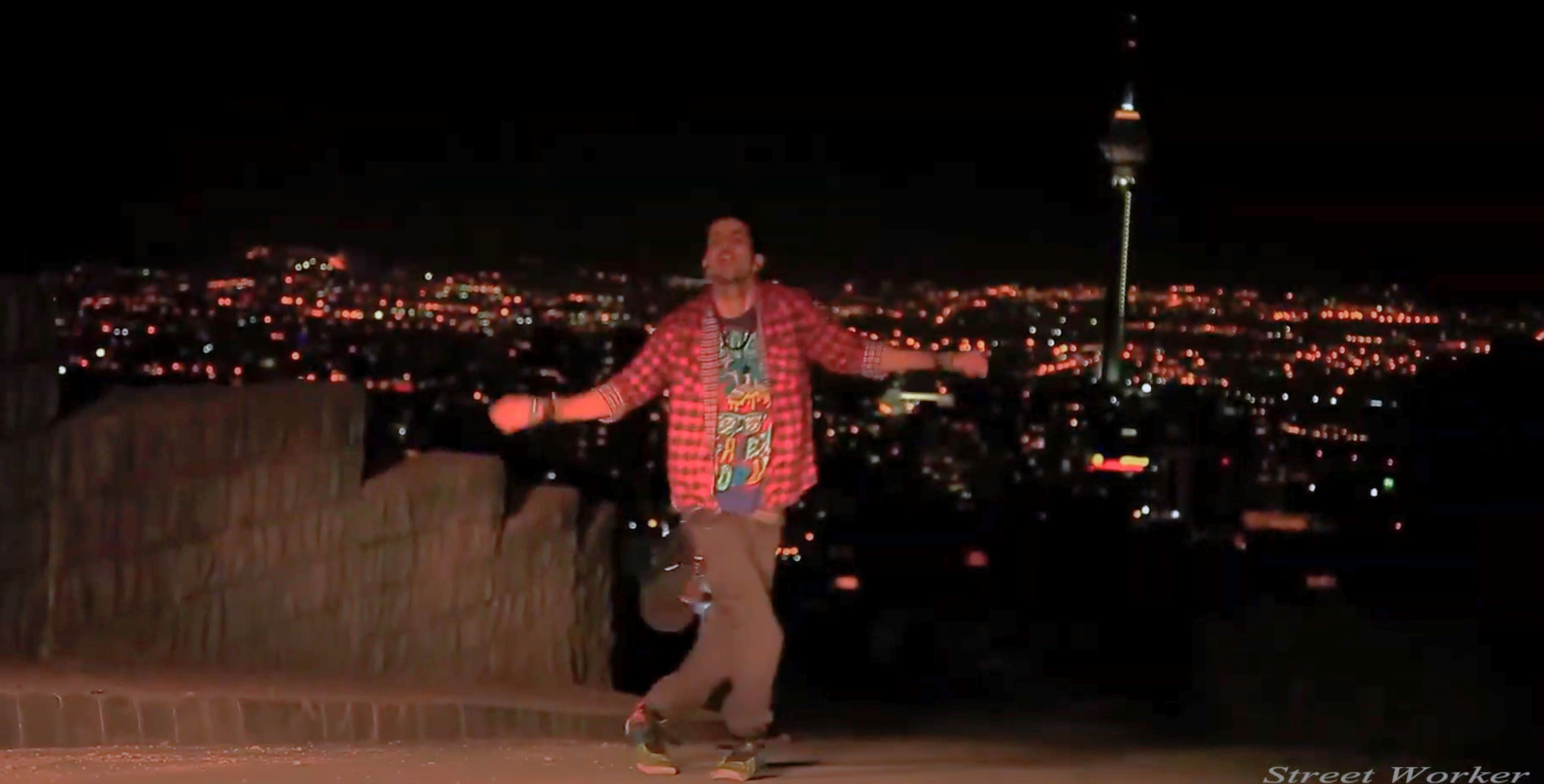
Still from Street Worker's video, "Start Hip Hop Dancing" uploaded to YouTube on December 15, 2015. Tehran's Milad Tower appears in the background.
Introduction
I rap, therefore I officially exist.
— Salome MC, "بهای رهایی" ("The Price of Freedom")1
Fun is serious business. My argument, developed here, is that hip hop, as a globalized grassroots social movement focused around the production and shared experience of art, is a form of street politics that has secured real social power for excluded urban youth in Iran. Around the globe predominantly poor, excluded, and urban youth are changing cities through hip hop, pushing back and replacing the authority of the state or filling its void with their own visions of culture, collective association, autonomy, and moral order. Perhaps more than any other artistic social movement before them, these rappers, dancers, DJs, and graffiti writers have changed the world through their artistic practices. Theirs is the story of a distinct kind of globalization: that of the grassroots.
Hip hop practitioners in Tehran, through their everyday leisure and artistic practices, are transforming the use and shape of the Iranian capital in order to make the city's infrastructure and symbolism produce value for them. In doing so, they, along with other cultural rebels, have compelled the Iranian government to make important, if limited, concessions with regard to the state's effort to control cultural production and consumption. These achievements are no small matter. These young artists and enthusiasts have carried out an artistic revolt that has resulted in real, albeit circumscribed, gains in social power.
In this paper, I have sought to tease out some preliminary observations about the particularities and spatial politics of hip hop in Tehran, using the insights of urban sociology as a primary framework to guide my analysis. Much of the extant English-language scholarship on hip hop has not discussed Iran's practitioners except occasionally.2 TThe growing body of scholarship in English on hip hop outside the U.S. in combination with a storied roster of formally and informally produced video documentaries have helped to trace hip hop's rise and emplacement in (among other countries) Cuba, Haiti, Mexico, Brazil, Colombia, Chile, Armenia, Turkey, Syria, Lebanon, Palestine, Yemen, Malawi, Tanzania, Kenya, Libya, Tunisia, Algeria, Morocco, Senegal, Ghana, Nigeria, the Central African Republic, South Africa, South Korea, China, and Japan, in addition to some of the more well-documented cases of France, the U.K., and Australia.3a There is, however, one exceptional work in English that has provided crucial insights for this present investigation: Hisham D. Aidi's Rebel Music: Race, Empire, and the New Muslim Youth (2014). Aidi's monograph does much to elucidate the interconnectedness of Black freedom struggles in the U.S., Black-American Islamic traditions, and the appeal of hip hop lyrics, music, and sampling practices to Muslim youth around the globe.3b Nevertheless, much work remains to be done to better understand the particularities of the various expressive practices that together make up hip hop, particularly dance and graffiti, and to situate the spatial politics of these differentiated yet intertwined subcommunities in relationship to the specific spaces through which they move and upon which they act. Part of the purpose of this paper, then, is to make some headway in redressing these oversights.
In formulating my argument, I build upon the insights and work of Asef Bayat, particularly his much cited concept of "quiet encroachment"4 and his account of the politics of fun in Iran5. Quiet encroachment as a conceptual lens for understanding how marginalized groups negotiate unevenly distributed, oppressive state presence in order to secure value from dense urban environments has much to offer the study and historiography of hip hop. Indeed, the notion of quiet encroachment echoes key aspects of Tricia Rose's prescient insights in her groundbreaking Black Noise about how marginalized groups produce and secure meaning, joy, and value within the context of systematic economic and sociopolitical exclusion, a point to which I return below. My goal here, then, is to place Bayat and the larger field of urban sociology in conversation with the insights of dance studies and performance studies in order to better understand what is at stake for hip hop practitioners in their choice of embodied expressive practices and how these choices act upon and transform the physical and political order of their urban environment.
A video posted by graffiti writer Gorbe entitled, "Tags, Throws and small Graffiti Bomb with Monzal in Tehran, Iran". Of particular note is how video obscures the graffiti writers faces and distorts their voices to protect their identities in order to share their process and work with a larger audience online through this video production. Gorbe, the graff writer whose YouTube page this video was posted to, created this YouTube account in February 2014.
This study uses news media articles, dance videos, rap music and lyrics, and social media content as its primary source materials and places a heavy emphasis on online sources. The internet played a significant role in the dissemination of hip hop at its most crucial period of popularization in Iran in the 2000s and continued to play an essential role through the 2010s and into the early 2020s in disseminating artistic works within the context of a political system which otherwise limited and monopolized access to formal distribution channels. It is therefore important to understand and analyze materials made available online given the ways in which Iranian practitioners and enthusiasts have made use of online means for accessing and distributing hip hop works.
This reliance on online materials has both its advantages and its drawbacks. One of the strengths of this approach is that it centers the artistic creations of the hip hop practitioners in these networks as shared through one of its primary distribution media. Online materials published to or shared on the social media website MySpace and on independent websites like persianhiphop.com, rapfars.com, rap98.com (and its mirror rap98.ir), and Bia2Rap played a formative role in the early years of Iranian hip hop in the dissemination of music, videos, still pictures, and news.6 Other sites like YouTube and SoundCloud would later come to dominate alongside the social media platforms Facebook, Twitter, and Instagram and the messaging applications WhatsApp and Telegram.7 The internet was and continues to be a vital distribution vehicle given the government's various prohibitions on music and dance combined with their control over national radio and television broadcasts and permitting processes for live performance, which severely limit hip hop practitioners ability to share their work through formal channels. This focus on online source materials, however, also limits the scope of this investigation to those who have sought to make their contributions known or accessible to a broader audience of internet users and, therefore, misses those who, either because of questions of access to the internet and recording equipment or because of their reasonable and strategic considerations around inviting the unwelcome gaze of Iranian state bureaucracy, could not or would not submit their expressive practices to documentation and internet availability. One crucial consequence of this choice is that it almost surely over-represents male participants in the Iranian hip hop zirzamin8 ("underground") given that prohibitions on dance and musical performance are differentially experienced and unequally enforced along the axes of sex and gender with even harsher consequences for women and girls, making their strategic calculations about the perceptibility of their participation all the more complex.9 Nonetheless, for those women and girls who have made their participation in Iranian hip hop known to a broader public, I have endeavored to highlight their important role in building a robust, varied hip hop culture.
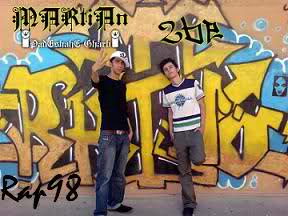
Iranian rappers 2be and Martian pose in front of wildstyle graffiti piece in an image from June 2007 watermarked with "Rap98", one of the earliest websites dedicated to Iranian hip hop.10 Watermarks were a common feature of early Iranian hip hop digital images and videos, often displaying the website to which the content was originally posted. The image here is small relative to images posted in later years to websites and social media, reflective of a need to limit file sizes for purposes of storage and for site visitors whose ability to access a media-rich site could be severely hampered by slow or irregular download speeds or unreliable internet connections.
My goals for this present writing are fourfold. First, this piece of writing serves to note some critical implications about the role that hip hop plays in activating and transforming the shape, use, and function of urban spaces. Second, this paper aims to suggest directions for future research. A third driving motivation is to question the characterization of absolute difference at the heart of much of the discourse about the United States and Iran emanating from political elites in both countries. Below the surface-level acknowledgement that Iranian youths' embrace of hip hop reveals shared cultural practices of U.S. origin, there lies a far more profound resonance between the authoritarian policing of Black bodies and culture in the U.S. and the Islamic Republic of Iran's efforts to control the expressive practices and media consumption habits of Iranians, particularly youth. Without having to reduce the complexity and uniqueness of either socio-historical situation to a bland and inaccurate equality, that Iranian youth would interpret the expressive practices of Black, Afro-Latin, and Afro-Caribbean youth in the U.S. through hip hop as resonating with their own experiences of exclusion, lack of meaningful economic opportunity, deep dissatisfaction with the prevailing political, social, and moral order, and longing for new ways of relating to the expressive potential of their own bodies is profoundly meaningful. Among other things, it highlights how Orientalist discourses of absolute alterity belie the parallels between how power and exclusion in Iran and in the U.S. have been exercised, a point which political elites in either country are unlikely to acknowledge, not least because their supposed polar opposition is politically useful to both sides.11
Lastly, I seek to bring together the original four elements of hip hop — breaking, graffiti, DJing, and emceeing — within an overview of the specific historical and sociopolitical context of Iran from the late 1990s through to the Jin, Jiyan, Azadî ("Woman, Life, Freedom") movement of 2022 around which time a markedly new generation of hip hop practitioners comes into view. This emphasis on locating the original elements as cultural forms within Iranian hip hop, while emphasizing both the historicity and cross-cultural present of these distinct though deeply imbricated expressive practices, serves to aid in tracing how and to what extent Iranian youth have indigenized and transformed these dynamic, evolving, and locally realized hip hop forms to reflect Iranian cultural priorities and lived realities. It also serves to maintain focus on how Black, Afro-Caribbean, and Afro-Latin cultural priorities continue to animate global hip hop practices. Far from positioning the four elements as transcendent archetypes that maintain some form of fixed identity outside of their embodied and material manifestations in spacetime and deracinated from their actual instantiation in disparate interpretive moments by distinct and changing actors, this approach shines a light on hip hop as an amalgamation of interwoven performance practices in a constant state of flux and in dialogue with a complex, dynamic network of actors, environments, meanings (historical, social, cultural, regional, individual, environmental, situational), and interpretive frames.
This approach also serves to reorient us away from the tendency in the academic literature and the media to prioritize hip hop's vocal and textual content to the occlusion of the ways in which hip hop practitioners describe and operationalize hip hop practices and performance. The extant research on hip hop in Iran concerns itself almost entirely with rappers and their lyrics with little mention of the wider array of expressive practices that constitute hip hop. This skewing of the research and popular analysis toward the oral and narrative dimensions of hip hop is true of both the academic literature in both English and Persian and of news media coverage.12 Such an imbalance tends to overlook or, worse, misrepresent how Iranian hip hop practitioners themselves operationalize and construct their richly varied expressive communities and practices. This logocentric bias is hardly unique to the writing and documentation of Iranian hip hop. As Greg Dimitriadias has noted about hip hop analysis more broadly, "The constant search for meaning through rap's vocal content alone has led to much cross-cultural misunderstanding, especially concerning the role of social dance. The link between protest lyrics and social resistance, for example, is often assumed, while the body itself is often ignored or dismissed."13 This skewing toward the oral and linguistic aspects of hip hop is arguably better suited to the specific context of Iranian hip hop than many if not most other global hip hop communities, not least because of the unique importance of poetry in Iranian culture, history, and national identity in combination with the technological and spatial realities of Iranian media, politics, and underground youth culture at the time of hip hop's rise there in the early 2000s, which is a topic that I return to below.
Nonetheless, hip hop in Iran, as elsewhere, is a vast and varied constellation of diverse networks of practitioners and their aestheticized practices within which rap, or emceeing, is one element among several.14 Hip hop is not reducible to discourse alone. It bears emphasizing: hip hop is not just rap, and rap is not just words. Scholarship and analysis must not lose sight of this crucial fact. For one, to deracinate the textual content of rap from its rhythmically and temporally embodied performance to music significantly reduces the scope of the interplay of meanings that give rap its full performative power. This is not to say that lyrical analysis does not produce valuable insights. Rather, this analysis, while necessary, cannot fully explain all that rap is doing within the fuller expressive assemblage where hip hop performance brings it into being and imbues it with the expressive dynamism that has been so fundamental to its cultural cachet. Put another way, if most of what rap has to express could be gleaned from lyrics alone, then the hip hop term, "spittin'", in English, which emphasizes emphatically embodied, spoken delivery rather than words or text, would not be the layered metaphor that it is for rapping. Lyrical analyses work best when they return us to the broader interplay of performative meaning-making which lyrical interpretation serves to enhance.
Moreover, an analysis which resituates rap and rappers within the constellation of aestheticized practices that Iranian hip hoppers themselves describe as "hip hop" (هیپ هاپ) is essential to understanding Iranian hip hop on its own terms and from the perspective of its diverse practitioners, who are far from monolithic and who can and do disagree with one another. The degree to which these practitioners and the hip hop practices that they take up interact with each other is essential to any analysis which claims to speak to the subject of hip hop in general and not just not just spoken, rhymed lyrics as the traditionally synecdochic hip hop practice. Does hip hop as Iranians realize its various practices constitute a series of more or less siloed aesthetic endeavors that merely share a linguistic label or are the boundaries between these practices more semantic than empirical? This is a key question that has so far been largely absent from the academic literature. This oversight suggests that we as scholars and analysts of hip hop have yet to fully account for the richness, complexity, variety, and depth of hip hop in Iran.
Even to the extent that hip hop practices across performative media may be sufficiently independent to warrant separate analytical treatments, we must at a minimum account for how it is that Iranians nonetheless find it meaningful to identify these varied practices as hip hop. As the research presented here shows, the Iranian hip hop scene is characterized by an active and rich interplay between hip hop's various originary elemental practices — rap/MCing, breaking/dance, writing/graffiti, and DJing/music production. Many Iranian hip hop artists' practice has traversed the boundaries between the traditional elements of hip hop. Furthermore, Iranian hip hop analysts, enthusiasts, and practitioners regularly incorporate the performance, works, and expressions of various hip hop elements into their productions thereby sustaining and reinforcing the linkages between distinct hip hop practices and expressive forms and constituting an integrated hip hop community in which dancers, writers, producers, and emcees collaborate collectively in the production of a uniquely Iranian hip hop scene.
The roughly twenty-five-year period upon which this investigation takes up its focus, from the late 1990s to 2022, marks the birth and maturation of the first generation of Iranian hip hop. Among other important developments during this timeframe is a notable diversification in hip hop practices of such an extent that they constitute distinct hip hop subcultures. This is not to say that hip hop's early years in Iran are characterized by a uniform or otherwise largely consistent set of aesthetic practices so much as it signifies two important developments: one, the clarity of differentiation between aesthetic approaches and methods among self-organized sub-groupings within the Iranian hip hop underground which make the subcultures designation meaningful; and two, the capacity of these subcultures outside Tehran and rap-e farsi (rap in Persian) to capture a national audience. Of particular note at the end of this period is the emergence and national success of rappers rapping in minority languages like Azeri and Kurdish and in different Persian dialects beyond that of Tehran. Given that one of the core goals of this investigation is to challenge the logocentric bias of the literature and to provide greater insight into hip hop practices beyond just rap, this choice of a temporal endpoint based in rap language may seem a curious one. My analysis, however, does not argue against the pivotal role of rap but rather argues for a fuller accounting of the diversity of practices that the Iranian hip hop underground claims as hip hop and how this very diversity of expressive practices gives meaning and dimension to Iranian youth's embrace of its constituent practices. Such a position, therefore, facilitates a more nuanced understanding of rap's positioning among the network of various hip hop practices in Iran as Iranians — and not just scholars and Western media — define them. Such a position need not preclude acknowledgement of the significance rap plays as a sociohistorical force.
Given this investigation's focus on Tehran, then, the period under consideration, which follows the rise and stabilization of Iran's first generation to produce a truly national hip hop scene, is appropriate in multiple respects. Principle among these, the choice of 2022 as the endpoint for this study marks the eruption of the Woman, Life, Freedom movement, a sociocultural watershed in Iranian history in which hip hop, including significantly Kurdish-language rap, played an important role. The complexities of that critical moment warrant a level of consideration and analysis that future investigations would better serve. Secondly, here is the emergence of practitioners who grew up with hip hop practices and cultural artifacts in the Iranian sociocultural milieu unlike their predecessors born in the decade following the postrevolutionary period in the 1980s.
What I present here is not a general theory of hip hop in Iran. Quite the contrary, what my research shows is that the dynamic interaction of multiple expressive cultural practices that have produced a distinctly Iranian hip hop culture and the resulting diversity in its forms is one of the reasons for its appeal as an expressive practice for excluded urban youth who lack formal institutional channels in which to pursue their interests. Given constraints of space, I will highlight a few ways in which hip hop is received, reproduced, and experienced in Iran by focusing on Tehran. From this basis, I offer some tentative observations about the larger structural forces that intersect with a handful of particular local experiences. Whether most or just some of these participants' perspectives are broadly shared with the artistic undergrounds of which they are a part is an important question that I must leave to future investigations. Nonetheless, these youths' unique observations about shared practices and experiences of oppression remain of critical importance.
What I seek to highlight is hip hop as an urban process and an amalgamation of locally realized expressive practices in which hip hoppers modulate and act upon the perceptibility of their participation in relation to strategic considerations about asserting their physical and cultural presence in the repressive context of Iran. Through their everyday leisure and aesthetic preferences and the activities through which they perform and embody those preferences, these youth have maintained and secured valuable autonomy while turning the infrastructure and symbolism of the city into producers of social and political value for excluded youth and fellow members of their communities. To have done so — and to continue to do so — reveals the seriousness of fun as a catalyst for change.
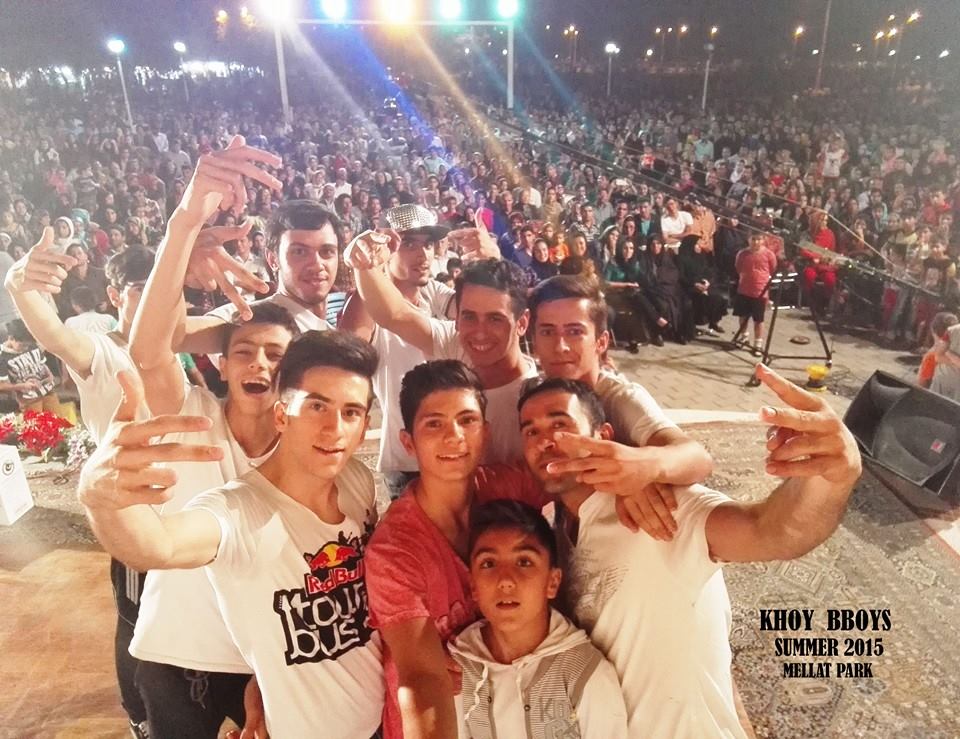
The Khoy B-Boys pose in front of a large crowd at Mellat Park in Tehran in 2015 (posted to their Facebook page).
Quiet Commotion: Autonomy, Joy, & State Presence
For those who do not connect with hip hop music, it may be "just noise,"15 but for others it can be hope, art, a vehicle for expressing and receiving deep truths about the experience of marginality, and a means of social and spiritual survival; something one can become by way of embodied practice; a different and even transformative way of relating to the space of one's community. Not everyone chooses hip hop, but for a significant number of the youth who do, it matters a great deal to them.16 For these young rebels, the very act of embodying its practices and appreciating its forms is considered valuable in and of itself for the autonomy that it implies and renders real. Salome MC writes about this crucial experience in relationship to her investment in making hip hop music and videos:
I was so in need of autonomy in my own work that I took it to the extreme and learned every aspect of music production so I can create what I want to create with absolute control. That wasn't enough; I got a master's degree in video production so I can make my own music videos too. This control gave me power; the power gave me more independence. It became one of the most important parts of my existence and played a big role in every choice that I made, no matter how big or small.17
The Islamic Republic's severe restrictions on access to unapproved cultural products, the state's monopoly over television and radio broadcasts, and the intrusive control exercised over performance permitting processes made the enjoyment of hip hop expression — or, indeed, any unapproved expressive practice — into an act of defiance. In this context, participation in everyday acts of expression take on new meanings in relation to state power.
Many Iranian youth have found in hip hop a way to embody personal autonomy from the state's efforts to enjoin expressive acts or to prescribe behavior. They also have resonated with popular histories about hip hop's role as an artistic and celebratory expression of collective resistance. As Tricia Rose poignantly argues in her pioneering examination of hip hop in Black Noise,
Under social conditions in which sustained frontal attacks on powerful groups are strategically unwise or successfully contained, oppressed people use language, dance, and music to mock those in power, express rage, and produce fantasies of subversion. These cultural forms are especially rich and pleasurable places where oppositional transcripts, or the "unofficial truths" are developed, refined, and rehearsed. These [...] dances, languages, and musics produce communal bases of knowledge about social conditions, communal interpretations of them and quite often serve as the cultural glue that fosters communal resistance.18
While Rose's analysis concerns hip hop in its country of origin, the U.S., much the same can be said for hip hop in Iran, where legal prohibitions on performance practices, particularly dance and music, and on unapproved expressive acts more generally, make direct confrontation and indirect subversion a routine consideration for many. Indeed, Rose's comment about the strategic wisdom of indirect confrontation resonates with a core thematic of Asef Bayat's insights about the necessity of collective action by Iran's urban poor in the postrevolutionary period. As Bayat demonstrates, Iran's urban poor deployed new strategies to pursue their claims in the face of state repression that were "low-key, nonprovocative, often individualistic, requiring patience, precision, and perseverance".19 While the South Bronx in the 1970s and 80s and Tehran after 1979 and heading into the 2000s defy simple comparisons, the parallels between approaches to indirect resistance among excluded populations in the context of dense urbanity in both locations, as Rose and Bayat rightly call into focus, present a rich area for investigation. Indeed, the very opposition that the national governments of Iran and the U.S., based as they are on a discourse of radical alterity, might very well belie shared or at the very least parallel experiences of urban exclusion and oppression — parallels that hip hop practitioners in Tehran have attuned to through their embrace of hip hop's expressive forms. In this way, we might think of hip hop in Tehran as activating a set of practices seen in other sociocultural and historical contexts, like in the Bronx, that excluded youth take up in order to enact their autonomy from the state through celebratory, expressive acts that provide a sense of social cohesion in opposition to oppressive state presences and systems of marginalization.
As Bayat demonstrates in his influential monograph Street Politics, Iran's urban poor, since well before the Islamic Revolution, have been engaged "in a silent, patient, protracted, and pervasive advancement of ordinary people on the propertied and powerful in order to survive hardships and better their lives" in a process which he calls "quiet encroachment".20 I argue that a process with many of the same features as quiet encroachment is occurring with hip hop practitioners in Tehran. These shared features include elements of "spontaneity, individualism, and intergroup competition",21 but with slightly different qualities, including a different spatial politics as well as participation from the middle class. They are engaged in temporary occupations of urban open spaces like parks,22 sidewalks, street corners, and back-alleys23 as well as enclosed and semi-enclosed spaces such as abandoned and decrepit buildings,24 abandoned homes,25 public recreation centers, and "aerobic" community classes26 where they record music and videos, practice and share their craft, and host performances, dance battles, classes, parties, and other events. Through their collective actions, they create fun while actualizing corporeal autonomy through their shared artistic practices and interests. These spaces where they embody their interests are experienced as zones of autonomy, circumscribed though they may be, where the state's reach is both symbolically and actually pushed back through a collective celebration of the leisure and artistic preferences of youth.
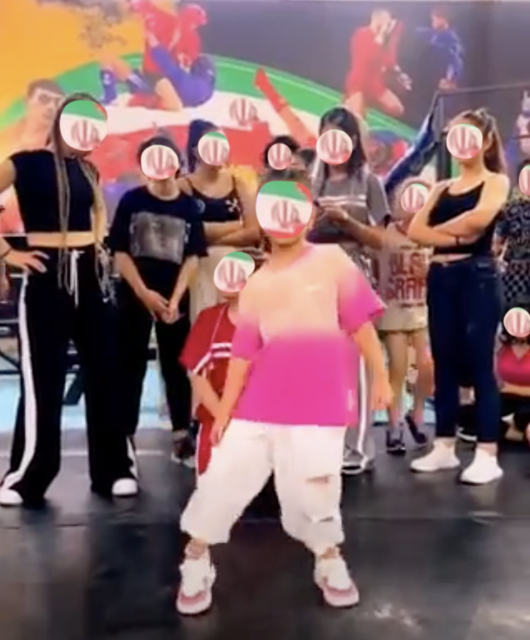
This modified still from a video whose title is given as "Raqs Zibâ Dokhtar Irâni" ("Iranian Girl Beautiful Dance") shows a young Iranian girl in 2022 preparing to perform a solo hip hop dance to the song "Gangesh Balas" by Iranian rapper Sohrab MJ. This video was shared widely on Instagram and Telegram.27 The image has been modified by the author to obscure participants' faces given that the relationship of the uploader to the participants is unclear.
Hiphâp-e Irânī: Features of Iranian Hip Hop
Hip hop is a complex amalgamation of practices and cultural traditions that first emerged in the South Bronx in New York. DJ-ing, breaking, and graffiti and later rap emerged as artifacts of African-American, Afro-Caribbean, and Latin Caribbean cultures in the U.S. Hip hop is, therefore, Western in its origin. However, hip hop practices as they are realized by Iranians and other disaffected youth in Southwest Asia, North Africa (SWANA), and elsewhere throughout the world are not simply reproducing Western cultural forms, as Usama Kahf has shown with regard to Arabic hip hop.28 Hip hop artists and practitioners throughout the SWANA region have been modifying and recontextualizing a set of deterritorialized aesthetic practices within the hip hop umbrella to create uniquely localized interpretations inflected with their specific cultures and in doing so have created new approaches and interpretations within hip hop's growing body of global aesthetic traditions.29
In the case of Iranian hip hop, this is evident in the lyricism, poetics, and wordplay of rappers, many of whom pull from a rich tradition of Persian poetry and build on literary and linguistic expressive practices that have long been a part of expressive traditions in Persian.30 Rappers and analysts both have emphasized the particular relationship of Persian culture to its long and storied history of poetry as a specific hallmark of rap-e farsi. Persian "is a very poetic language. And poetry is very important in Iran — every house has a book of Hafez poems," stated Salome MC, further adding, "Maybe that is why hip-hop is so popular."31 Hip hop analysts in podcasts32 and enthusiasts in online forums33 have noted a key feature of rap-e farsi, which is the complex, layered metaphorical expressions which can make understanding rap lyrics difficult to parse for native Persian speakers and Persian-language learners alike.
"The Law is Banned": A Hip Hop Zīrzamīn Forms
A brief overview of the rise of hip hop practices and of the Iranian government's regulation of dance and music provides some essential context for hip hop's positioning within the Iranian political and cultural milieu. Hip hop in Iran got its start in the 1990s, at a time when popular music was still banned.34 In hip hop's earliest days, informally distributed tapes and CDs, passed hand to hand, played a formative role in creating interest in rap music just as contraband satellite channels transmitting music channels from abroad provided Iranians with some of their first experiences with rap and hip hop dancing.35 Some of these tapes and CDs by rappers like Tupac Shakur made their way into the country when men on international business trips purchased them abroad and carried them back into the country as gifts for their children.36 Some enterprising youths translated the English lyrics and connected deeply with the social messages that they found in U.S. rappers' lyrics. As YAS, the first rapper to legally release his music in Iran, remarked,
After a while I started to pay closer attention to the music [and] I realized there was a lot more there to it, he [Tupac] was talking about real issues. I started to translate the lyrics and realized he's singing about society and the culture, about his perspective. I realized then that any kind of music that was going to stick around and have any kind of lasting effect had to say something real. It had to have a message and a deeper significance to it, in any kind of genre.37
Word of mouth was critical in helping to popularize hip hop dance and music. Numerous rappers, dancers, and other hip hop creators make reference to word of mouth in the research as a critical conduit for disseminating information about music, rappers, classes, performances, and other events.38 As a hip hop zirzamin took shape, rappers, musicians, and music producers utilized and created clandestine recording studios to facilitate production outside of the watchful eye of state officials. Illicit concerts were held in private homes and abandoned buildings where participants shared ideas, enthusiasm, and techniques.39
Dance and music as cultural performance practices have occupied similar positions in post-revolutionary Iran as sites for and objects of socio-political and moral contestation. As Farzaneh Hemmasi observes, "Music and dance have been the most challenging art forms to reconcile to the pious, revolutionary vision of Iranian culture, both because they have long histories of being considered morally suspect in Iran and because of their prominence in prerevolutionary Iranian popular culture."40 Dance has been illegal in Iran since the 1979 Revolution, and punishments include imprisonment, fines, and flogging. Certain kinds of aesthetic movement in performance are permitted, however, in the form of "rhythmic movement" (harikat-i mawzun), which is distinguished from dance and, therefore, not subject to the same legal interventions:
Appropriated through a renaming and reshaping of the dancing subject, the genre of rhythmic movements was constructed to counter the previous associations of dance (raqs) with immorality, corruption, and 'imitated modernity' (tajaddud-i taqlidi) largely instigated by the image of the unconstrained dancing subject of the popular entertainment scene of cabaret and European social dancing in the Pahlavi era, particularly the cabaret dancer.41
In the context of the strict religious politics of the Islamic Republic of Iran, the very act of embodying hip hop practices or playing hip hop music represents a multivalent form of rebelliousness. For one, hip hop as a set of artistic practices whose historical origins and continued media influence are centered in the U.S. mark it as Western, as one Iranian hip hop dancer laments,
Hip hop dancers in Iran are just as good as in many other countries where the sport is popular, and that's no mean feat given the challenges they face. Unfortunately, the Iranian authorities won't let us hold official events. I really do not understand why. [... T]hey won't give hip hop a chance because they see it a Western dance and therefore a sign of Westernization.42
This issue of Westernization when it comes to performing hip hop dance in particular is compounded by the Iranian government's view in the post-revolutionary period of all raqs as un-Islamic and therefore corrupting.
Unlike with raqs, the Islamic government of Iran has adopted varying policies with regard to limitations on music. Ayatollah Ruhollah Khomeini, the first Supreme Leader of Iran, declared just months after the revolution brought an end to the Pahlavi monarchy, "If you want independence for your country, you must suppress music and not fear to be called old-fashioned. Music is a betrayal of the nation and of youth."43 Likening it to opium, Khomeini called for a sweeping ban of most kinds of music, save classical and traditional Persian music, religious songs, and music for special occasions such as weddings, couching his rhetoric in terms of saving youth from corruption.44 In 1997, following the election of reformist Mohammad Khatami as president, the Iranian government relented in its efforts to ban all forms of popular music. Certain kinds of popular music were legalized in official channels, subject to the approval of the Ministry of Culture and Islamic Revolution, but in 2005 newly elected president Mahmoud Ahmadinejad ordered the enforcement of a ruling by the Supreme Cultural Revolutionary Council — which Ahmadinejad headed — banning from television and radio all Western music, calling it "indecent".45 The ban's broad sweep kept hip hop, too, off the airwaves. While hip hop was not specifically singled out among Western music styles in the 2005 ban, it nonetheless over time became a subject of note in the minds of state functionaries as something worthy of official comment such that in 2010, Hossein Sajedi-Nia, Tehran's chief of police, referred to hip hop as "morally deviant" music.46 Lost among the crowd of Western music types making their way into Iran via unapproved and oftentimes outright illicit channels, hip hop in its early years had enjoyed a certain degree of anonymity — at least in the eyes of officials. This was not to last. At least in Tehran, as the genre continued to reverberate in the ears and bodies of Iranians, it ceased to blend in among the other musiqi47 resounding through speakers and walls, streets and alleyways of the capital city.
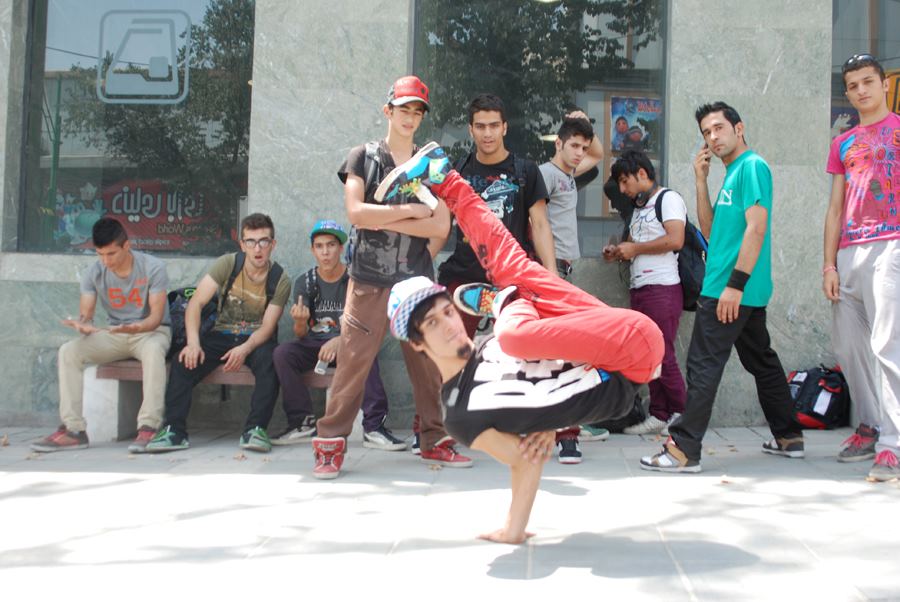
A b-boy performs a breaking freeze on a sidewalk in Tehran in 2012 (posted to the Khoy B-Boys' Facebook page).
"Throw 021 up Forever": Hip Hop in Tehran
Tehran ye chizi ro to man koshté
Tehran man hanooz dastam moshté
Tehran, âsmounat siyé chorde
Inja kasi âzâd mishe ke morde
— Roody, "Tehran"54
Official prohibitions on raqs and Western music notwithstanding, youth have held illicit house parties in Tehran where many times they play Western music and consume alcohol and marijuana.55 These parties, because of their illegality, require at least the tacit tolerance of neighbors if not their outright support in order not to invite interference by the police. Neighbors, then, have been functionally implicated in the youth's illegal efforts. As one journalist put it, "The most important relationships many of them have are with their neighbours. Small but necessary violations of Iran's law require, quite simply, that neighbours keep silent for each other. You either get away with it — or someone squeals."56 These gatherings, though prohibited, are necessary because they are a vital source of fun and autonomy. When neighbors do not alert authorities to the quiet commotion next door, they aid the youth by denying the state the resource of their knowledge and therefore the opportunity to intervene. Through their parties, these young rebels have activated networks of neighbors in preserving their temporary spaces of autonomous, hushed commotion. Occasionally, too, police are willing to turn a blind eye.57 The situation is, nonetheless, one defined by precarity for these youth, since their success depends on the fragile but vital alliance of a network of actors whose collective decisions influence the state's capacity to intervene in their communities.
Of course, not all neighbors in such a densely populated city as Tehran are always so keen to tolerate loud music, as Bahman Ghobadi's 2009 film, No One Knows About Persian Cats, portrays.58 In one scene, the two main protagonists Negar and Ashkan arrive at the rooftop of a multi-floor residential building during the daytime to meet with members of an alternative rock band who are positioned along different edges of the rooftop's perimeter.59 The band members peer over the side monitoring some out-of-frame points at the base of the building as they explain to Negar and Ashkan that they are watching for the departure of a particular neighbor. This neighbor, they say, calls the police when the band rehearses in their small, informal rehearsal room that the band built on the building's roof using found and donated materials — a necessary precaution to moderate the audibility of their rehearsals and also presumably to prevent direct lines of sight from neighboring buildings. Their vigilance, it is clear, has been ritualized to assure their ability to rehearse without the interfering neighbor's summoning of the authorities, as one of the band members comments about the neighbor not having left at their usual time. As soon as they see the neighbor in question head out, the group moves into the makeshift shed to begin rehearsal. While the scene itself is fictionalized, it nonetheless represents important aspects of the real and shared experiences of many Tehranian youth participating in Iran's diverse musical underground. Adjusting the timing, visibility, and audibility of their unapproved expressive practices is an essential strategy, a point that is further reinforced during the same scene of the movie when one of the band members comments about quietly warming up on the drums using clothing to cover the batter heads in order to mute the sound while the other band members monitor for the complaining neighbor's exit.60
As No One Knows About Persian Cats shows, Tehrani youth strategically modulate the perceptibility of their participation in unapproved performance practices in order to pursue their interests and develop their skills all while minimizing the risk of intervention by state actors and those who would facilitate state interference. They pursue these interests in spite of the costs and risks that the state's prohibitions impose. This in itself is remarkable evidence of the value that youth find in embodying these practices and pursuing their passions. To have fun, to joyfully and creatively express oneself by engaging in artistic and expressive practices that align with one's interests must, in this light, be viewed as an end in itself, whether as a source of deep meaning or fleeting pleasure particularly given that the state's efforts to heavily restrict or even outright ban participation in formalized economic channels that could remunerate their talents and passions functionally eliminated the possibility of regular or dependable compensation for their pursuits — much less careers based upon them (all the more so for the first generation of hip hop practitioners's early years). Little else plausibly explains the sustained effort that youth invest and the risks they regularly assume to pursue such pleasures particularly when the costs loom large, exacting prices both big and small ranging from menial precautionary measures to the risk of the full weight of the state's punitive power.
Temporary occupations of public spaces and abandoned buildings, in addition to those events held in private homes and building basements,61 have been essential to the production and maintenance of this youth-led hip hop zirzamin. Several kinds of sites for temporary occupations by these hip hoppers come up in the research. These sites have included Tehran's streets and back-alleys, public squares, community centers, and public parks, in addition to the enclosed, private residences mentioned above. In other cases, these youth and their collaborators have occupied spaces on a more permanent basis. At least one case has been documented of a group of hip hoppers taking over a vacant building in Tehran and repurposing it to serve as a hip hop club with a dance floor.62 These hip hoppers do not always succeed in avoiding the state's intervention, however. In 2010, the daily Iranian newspaper, Tehran-Emrooz, described a building that had come under police surveillance for its use as part of the city's underground rap scene. A number of men and women were arrested in a series of raids.63 Arrests do happen, and as such, precarity in many ways is a structurally determined aspect of these youths' work to establish and maintain these autonomous spaces. Some youth in their interviews with online media have acknowledged the real risks of being arrested. Whatever their hardships, illegality has not stopped these hip hoppers from realizing their interests and corporeal autonomy through temporary acts of quiet commotion.
Many Iranian rappers express dissatisfaction with the authoritarian government and the suffocating political environment in their rap lyrics. Erfan gained a name for himself in Iran as a rapper but eventually left for California, where he continues rapping about Iranian politics. In one of his raps, he laments "suffocating [...] exile".64 Salome MC raps in "No Revolution" that as a young person she feels the solution is either to leave Iran, to have another revolution, or else to wait for the violent collapse of the Islamic government.65 She left Iran in 2010 to pursue her graduate studies in Japan.66
The antagonism which pervades the relationship between Iranian hip hop artists and the theocratic regime is in no small part fueled by the efforts of government officials to control and restrict expressive forms deemed by officials to be threats to the moral order of Iranian society and Islam. Nonetheless, these hip hop artists' work continues to be popular among youth, as rapper Azad Right attested in 2015, "I know for a fact that hip-hop is huge in Iran — that rebellious, revolutionary mentality is something a lot of the youth resonate with."67 While we should exercise due caution when assessing artists' statements about the reach of hip hop in Iran at various historical junctures, since they themselves were and are invested in the success and continuation of their chosen genre, there is reason to believe that comments such as Azad's are not merely rhetorical flourish. Indeed, a statement by Hussein Noosh-Abbadi, a spokesperson for the Ministry of Culture and Islamic Guidance (Ershad), about the detriments of hip hop music and culture and the ban on hip hop concerts the same year as Right's statement tacitly recognized that hip hop was at least popular enough to necessitate government intervention and the allocation of government resources to the enforcement of such efforts, however piecemeal and incomplete those efforts might have been.68 Noosh-Abbadi's statement, emanating as it did from an officialdom invested in limiting hip hop's reach and appeal and in burnishing its own image as an effective intervenor in unapproved cultural practices, then, helps corroborate Right's assessment. Such efforts to limit and ban hip hop-related activities must also be viewed in the broader context of what Asef Bayat calls Islamists' "war on fun":
The fear of enjoyment is a singular feature of these Islamist states and movements, whose doctrinal models are unable to accommodate — and so are compelled to reject and seek to deligitimise — expressive behaviours that are at the heart of human life: even including playfulness, laughter, and displays of fashion. These power-driven forces seek to reinforce their case by depicting such behaviours as part of a 'western cultural invasion.'69
Hip hop, thus, is at the intersection of a number of outright prohibitions and undeclared but nonetheless real interventions by the state, including as a creation of Western culture, as music, as dance, and as unsanctioned expressive behavior.
Iranian hip hop artists and enthusiasts have reclaimed digital and symbolic space through corporate media networks and their publishing platforms. Many of these youth published videos and photos of their performances, dances, gatherings, and events on sites like MySpace — a key social media site for Iranian hip hop particularly in the early to mid-2000s — and, later, on YouTube, Instagram, Facebook, Twitter, and to a lesser extent the France-based video site and YouTube-competitor Dailymotion. In so doing they have made their take on hip hop available to a global audience of internet users. They also utilized virtual gathering places like Yahoo! chatrooms70 and online forums that they themselves created like rap98.com. In the wake of widespread protests of the reelection of Ahmadinejad in 2009, many of these social media sites were banned; however, videos and songs continued to be posted. The government's ability to prevent Iranians from accessing and publishing illicit content online has proven limited,71 and similar efforts to thwart the use of illegal satellite dishes has been at least as unsuccessful as the attempts to prevent access to unauthorized websites.72
Many Iranians circumvent government internet filters and gain access to unapproved websites and online media through the use of virtual private networks (VPNs). VPNs encrypt the data exchange between the connecting device and the intermediary server. They also allow users to connect to the internet by way of an intermediary server that masks their internet protocol (IP) address, which is the unique digital identifier assigned to a device that allows it to exchange data on a network like the internet. IP addresses can be thought of like a postal address for a network-connected device in that they provide information that uniquely identifies the connected device allowing data (or "mail" in this metaphor) to be exchanged between the device and the network. IP addresses can be used to identify a connected device's general location as well as the internet service provider (ISP) providing the connection. A core function of VPNs, then, is to make the IP addresses and data exchange inaccessible to others.73 The Iranian government for its part has attempted to combat the influence and appeal of unapproved media by establishing regime-approved analogues of popular web services with sites such as Mehr.ir, a video-sharing site for Persian-speakers which only shows regime-approved content.74 The cultural contest between regime-approved and unapproved content platforms, however, has decisively favored unapproved channels perhaps going as far back as 2002, when Iranian rap videos first appeared.75
This video montage, posted to YouTube, shows a variety of clips from the Khoy B-Boys breakdance crew from Khoy city in West Azerbaijan Province, Iran. The video shows a wide variety of places and spaces where the Khoy B-Boys have practiced and performed their breakdance work.
Conclusion
Hip hop has enjoyed enduring popularity among teens and young adults of ghettos, slums, and projects the world over since its beginnings in the South Bronx in the 1970s. This popularity has aroused suspicion and been subject to legal interventions by a variety of national governments, including those of Iran, France, and the United States — and this in spite of their apparent differences in structure and regarding their claims around the acceptance of free expression.76 The leisure and aesthetic preferences and community and social practices of youth, and primarily youth of color, are thus a site of intervention for authoritarian and democratic governments alike. This would tend to indicate, then, that hip hop practitioners' collective embrace of a street politics of everyday resistance, autonomy, and joy poses a meaningful challenge to state power across a broad spectrum of political systems. It also reveals the ways in which the symbolic and performative cannot be easily disentangled from, much less categorically opposed to, the "real" or materially consequential. This fact alone poses some deeply interesting issues for the fields of performance studies and urbanism.
By redefining their relationship to urban space through their collective embodied practices, hip hop's young rebels have created an urban social movement in Manuel Castells' sense of the phrase: "a collective conscious action aimed at the transformation of the institutionalized urban meaning against the logic, interest, and values of the dominant class."77 Through hip hop, youth and their collaborators have appropriated sites and techniques of cultural production and made them better represent their interests and sense of moral order. The expressive culture of youth, rich with knowledge about the massive global upheaval that has been going on in cities since the advent of neoliberalism, was subsequently broadcast to a global audience. In the cases of the hip hop artists that I have looked at through my research, their everyday aesthetic and leisure practices have achieved for them an immediate form of spatial autonomy, which is itself considered a vital resource. This sense of autonomy is reinforced by a lyrical tradition in rap that makes frequent mention of "freedom" and being "free". In other words, my research shows that fun is a quite serious matter where real questions of power, corporeal autonomy, agency, identity, and enjoyment are at stake. While hip hop has not been a panacea for all of its practitioners and while these youths' achievements continue to be circumscribed in other important ways, we must nonetheless conclude that hip hop has produced real social, political, and spiritual power for some of the most excluded inhabitants of the world's cities.
In staging a so-far successful artistic revolt, hip hop artists and their collaborators have created new meanings and uses of urban space and extended their social and political power in the city. Their exclusion from formal channels through which to redress their marginalization made hip hop, with its global reach and sociopolitical expressive currents, a particularly appealing and well-suited performative practice for the urban poor, particularly youth of color in the U.S. and oppressed youth globally. With incredible passion and persistence, these young artists opened space for themselves in global communication channels and broadcast to the world performative representations of and responses to ghetto life, racism, poverty, and the violence of the urban order that surrounded them. Their exclusion became a collective reference point and subject matter for much of their work and for many of the artists that have since followed, who took hip hop and shaped it in their own localized ways. For all these reasons, hip hop and its practices serve as a vital tool for understanding urban experience, contemporary youth social movements, and urban change in cities of both the global South and North. In the context of sustained structural exclusion in slums and ghettos, these rebel youth have managed to obtain real gains for themselves and changed cities in the process.
Suggested Citation for this Paper:
- Behan, Brendan P. 2025. "Quiet Commotion: Street Dance, Hip Hop, and Social Change in Tehran". 2016. Last modified June 12. https://brendanbehan.dance/research/papers/hip-hop/quiet-commotion/.
A Note About URLs & Hyperlinks
*A Note of Caution Regarding URLs and Hyperlinks*: This paper and the sources listed on this page sometimes reference URLs that no longer point to the original content to which this research refers. It should be emphasized that URLs (including active hyperlinks and inactive text URLs), content, and ownership/control over web domains can and do change. Therefore, it is strongly recommended that due care be exercised in attempting to access URLs and hyperlinks, particularly older content. In instances where the author suspects that a change in ownership or control over a host domain may have occurred, they have endeavored to note their suspicions.
Endnotes
- 1 This is Salome MC's own undated translation of the opening line of "بهای رهایی (The Price of Freedom)" (2014), https://www.salomemc.com/lyrics/The%20Price%20of%20Freedom%20(ENG%20TRANS).pdf (accessed March 5, 2025).
- 2 Hisham D. Aidi's monograph, Rebel Music (2014), as discussed later, while a brilliant exception in the literature on hip hop for its investigation of Muslim youth culture, mentions Iran at various points but primarily with respect to its relationships and rivalries with the U.S. and Saudi Arabia. Aidi's focus, which is indisputably a valuable one, is on the socio-political dimensions of hip hop music, U.S. imperial ambitions, and music as a site for and object of political contestation. Rebel Music, as the title suggests, centers rap and hip hop music but does not take up dance forms or Iranian hip hop practices.
- 3a [[SRCs: Cuba, Haiti, Brazil, Colombia, Chile, Turkey, Palestine, Yemen, Tanzania, Kenya, Algeria, Tunisia, Senegal, Ghana, South Africa, South Korea, Japan, Armenia, Ireland, Australia, and France]].
- 3b See also Curtis (2002), Jackson (2005), and Daulatzai (2012) for in-depth discussions of the complex historical relationship of Black American Islamic thought and practice in the U.S. with immigrant Islamic traditions, Sunnism, Black internationalism, and Islam in the Middle East and Asia. Daulatzai (2012) in particular offers a penetrating examination of the resurgence of Islam and Malcolm X in rap lyrics and hip hop music videos in the U.S. in the 1980s and 90s, which is situated within the broader historical context of anti-Muslim sentiment, decolonization struggles the world over, and U.S. military interventions in predominantly Muslim countries.
- 4 1997, p. 7–8.
- 5 See Bayat (2012a) in the chapter entitled, "The Politics of Fun". Bayat (2010a) further comments in "Iran: Torch of Fire, Politics of Fun", "Any occasion of festivity and spontaneous life — informal gatherings at street-corners, concerts and sporting contests, student parties and even bustling shopping-malls — is regarded by Islamist zealots with profound disdain."
- 6 See Bia2Rap, n.d. (likely 2014), bia2rap.com, https://bia2rap.com/about/ (NOTE: Navigating directly to the original URL is not recommended as site ownership appears to have changed), accessed April 1, 2025; Chopra, 2008a and 2008b; and Internet Archive's The Wayback Machine archival captures, https://web.archive.org/web/20070502020330/http://www.rap98.com/ and https://web.archive.org/web/20070615134909/http://www.rap98.ir:80/.
- 7 The importance of social media as a vehicle for Iranian youth to discover cultural products, exchange information with each other, and share their interests in music, performance, and performers is well expressed in Ershad, August 24, 2022, who quotes a fifteen-year-old girl from a village in Eastern Iran as saying, "And I find the news about the topics which I'm interested in on social media, such as Instagram or Telegram channels. I'm interested in lifestyle news, Hollywood, fashion and music." She continues, "We have some gatherings with friends from time to time at home. However, because we live in a village, there's no cafe or library around, so our social life is mostly on social media. I have many good friends who live in other villages near us. I'm in contact with them through social media. We exchange messages about the latest music videos they have seen, movies, fashion and gossip too on WhatsApp groups with friends. My favourite music genres are rap and hip-hop, R&B and some pop. It's the same with almost all my friends. I like mostly Iranian artists but I also love international ones like Eminem, Adele, Harry Styles and Zayn [Malik]." An article by Forsberg, 2012, in the Swedish press covering female rapper Ghogha's performance at an Iranian hip hop concert in Sweden quotes one young Iranian concert-goer, "Hon har tagit sig ända hit och säger de här fantastiska, starka grejerna. Många är här för att dokumentera och det kommer att spridas på Youtube. Det här är en av de grejerna som är viktigast för kampen i Iran." The concert-goer's comments illustrate the importance of YouTube, specifically, as an outlet for Iranian youth to document and disseminate contestatory views and dissenting artistic expression in hip hop.
- 8 .زیرزمین
- 9 Speaking of Islamism in the Iranian context and then broadening the perspective out to multiple national contexts, Karin Van Nieukerk (2011) notes in "Artistic Developments in the Muslim Cultural Sphere: Ethics, Aesthetics, and the Performing Arts", "Female bodies-in-motion are particularly scrutinized, and the female dancers have to cover their bodies with a loose costume. They have to move for a defined purpose, such as carrying props, or move in a way that resembles prayer. [...] Gender and the sexuality of performing bodies on stage remain a prime problem for Islamists, and for that reason the body must be neutralized or desexualized," p. 20–21.
- 10 Rap98, June 14, 2007, rap98.ir, archived by the Wayback Machine on June 15, 2007, accessed April 2, 2025, https://web.archive.org/web/20070615134909/http://www.rap98.ir:80/.
- 11 In an incisive piece of writing critiquing U.S. militarism in the wake of the release of "The Afghanistan Papers" by The Washington Post in December 2019, MC Salome, 2020, discusses the notion of the usefulness of the U.S. and Iran's mutual enmity: "Effectively, the Iranian government's ideological influence inside and outside its borders is the anti-thesis of the American presence. It only exists because of it, not despite. Iran can go to the countries ravaged by American interventionism and tell them you need us, have us, which is practically what [Qasem] Soleimani has been doing in Syria and Iraq. A last resort for any country leader facing opposition from its people is to divert attention from internal problems by bringing a foreign threat to the table."
- 12 [Skewed Research]
- 13 2012, p. 581.
- 14 There is a notable amount of ambiguity in the writing on hip hop, particularly in media reporting, about whether the word "rap" sometimes refers to spoken lyrics, rap music, both of these, or hip hop as a musical genre more broadly. For the purposes of this paper, when I reference rap without any other accompanying qualifier, I am referring exclusively to rhymed, rhythmic spoken lyrics or emceeing. When I mean to refer to the music or other sounds that accompany rap compositions, I will use the phrasing, "rap music", or some other explicit reference that indexes the sonic objects that are not themselves rap, whether instrumental music, beatboxing, sampled sounds, or other audio.
- 15 See Clarke, October 9, 2015. "Noise" references multiple sources in hip hop, including Public Enemy's famous track, "Bring the Noise" (1988), and Tricia Rose's landmark, Black Noise (1994), the first academic monograph examining rap music and hip hop in the U.S.
- 16 See the quoted lyric from Salome MC's "Bahâ-ye Rahâyi (The Price of Freedom)" (2014) which opens this paper.
- 17 Salome MC, 2019, n.p.
- 18 1994, p. 99–100.
- 19 Bayat, 1997, p. 75.
- 20 Ibid, p. 7.
- 21 Ibid.
- 22 The Observer, August 29, 2013, n.p. See also photographic evidence posted by Khoy B-Boys, Facebook, July 27, 2015, https://www.facebook.com/photo/?fbid=736739233103196&set=ecnf.100003013787282, which captures a photo of the hip hop dance group after a "ceremony" (marâsem) in Mellat Park, Tehran.
- 23 Khoy B-Boys, Facebook, July 27, 2015, n.p.
- 24 Chopra, April 16, 2008, n.p.
- 25 Arjomand, April 22, 2010, n.p. "Today, I teach hip hop in parks, where there aren't too many people, or in sports clubs, where I officially teach 'physical exercise' or 'coordinated movement'."
- 26 The Observer, August 29, 2013, n.p.
- 27 ^ Back to text Ershad, ibid.
- 28 Kahf, 2012, p. 117.
- 29 See Mirko M. Hall and Naida Zukic's discussion of deterritorialized musical practices, "The DJ as Electronic Deterritorializer," in Attias et al., 2013, p. 105–106.
- 30 Shayan comments in an interview in AAMIROO and Shayan, 2023, about Persian rap's "very homegrown sound" (17:15) noting further, "I think Persian language in general is, like a super poetic language, and, like, many of these rappers have the opportunity because of the attributes that Persian has to, like, create abstract stories and abstract use of, use of words that you don't see as much in other contexts, and that is the main thing that, like, you, you listen to some songs and you're like, What is he talking about?, but it's, like, super poetical and interesting" (29:21–29:52).
- 31 Quoted in Khaleeli, May 10, 2011, n.p.
- 32 AAMIROO and Shayan, ibid. Listen in particular to 29:53–31:15.
- 33 "Iranian Rap Music Is Top Tier", Reddit thread, January 4, 2025, https://www.reddit.com/r/iran/comments/1htgnna/iranian_rap_music_is_top_tier/ (accessed March 16, 2025). Original post by username ManicPixieDreamPearl.
- 34 Dagres, January 6, 2014, n.p.
- 35 Ibid.
- 36 Amigone, January 12, 2009, n.p.
- 37 Quoted in Amigone, ibid.
- 38 Dagres, ibid.
- 39 Amigone, ibid.
- 40 "Iranian Popular Music in Los Angeles," in Van Nieuwkerk, 2011, p. 87.
- 41 Zeinab Stellar, "From 'Evil-Inciting' Dance to Chaste 'Rhythmic Movements': A Genealogy of Modern Islamic Dance-Theatre in Iran," in Van Nieuwkerk, p. 231.
- 42 Alireza MJ (a likely pseudonym) quoted in The Observer, August 29, 2013, n.p.
- 43 Kifner, July 24, 1979, n.p.
- 44 Ibid.
- 45 Quoted in Pace, December 19, 2005, n.p. See also CBC News, December 19, 2005, n.p.
- 46 Ferani, November 10, 2010, n.p.
- 47 Hemmasi defines the Persian word, musiqi, as "an Arabic term of Greek derivation that refers to nonreligious sonic forms of questionable morality." Ibid., p. 88.
- 54 Roody, 2019.
- 55 Ferani, ibid. Gol, meaning "flower", and alaf, meaning "weed", are among the more common slang terms for marijuana in Persian.
- 56 Ibid. Emphasis added.
- 57 Ibid.
- 58 Kasi az Gorbehayeh Irani Khabar Nadareh, 2009.
- 59 Ibid., 00:40:35–00:43:13.
- 60 Ibid., 00:41:58–00:42:03.
- 61 Lavelle, August 3, 2015, n.p.
- 62 Source to be posted (note as of May 16, 2025).
- 63 Ferani, ibid.
- 64 Quoted in Ferani, ibid.
- 65 Salome MC, "No Revolution", April 10, 2013.
- 66 Khaleeli, ibid.
- 67 Azad Right quoted in Alexis, January 9, 2015, n.p.
- 68 Lap, January 4, 2015, n.p. See also Hemmasi, ibid., in Van Nieuwkerk, p. 102.
- 69 Bayat, 2010a, n.p.
- 70 Holland, September 21, 2018, n.p.
- 71 Etehad, April 19, 2014, n.p.
- 72 National Council of Resistance of Iran Foreign Affairs Committee, August 28, 2013, n.p.
- 73 It has not been until more recently that the government has attempted to crackdown on the use of VPNs to access the internet. See Motamedi, February 24, 2024, n.p.
- 74 Qing, December 10, 2012, n.p.
- 75 As of November 6, 2016, a majority of highlighted videos featured on the homepage of Mehr had accumulated views in the low thousands or fewer whereas an amateurly recorded video posted on October 25, 2016, by Iranian rapper Amir Tataloo managed to accumulate over 80,000 views in just over a week with just one video. Tataloo's Facebook page boasts over 1.2 million fans and subscribers. For more, see Dehghan, December 3, 2013, n.p.
- 76 For an excellent overview of legislative and judicial actions against rap and rappers since the 1990s in the French case, see Hammou, 2014. More recently, hip hop dancers and choreographers Ambre and Fabrice "Fabbreezy" Labrana discuss the "encadrement de la culture hip-hop" ("the controlling of hip hop culture") in France through the effort to impose qualification requirements on hip hop dance instruction in Kobini, "Hip-hop : pourquoi la loi 1149 pose problème ?", YouTube video, March 4, 2024, https://www.youtube.com/watch?v=lUo-nWBHPHA (accessed April 10, 2025).
- 77 The City and the Grassroots, 1983, p. 304.
References
Artography
- A1one (Karan Rashad). 2009. "streetcalligraphy2.jpg" (Media File Name). KolahStudio, "Persian and Arabic Graffiti From Iran", April 14, 2013. http://www.kolahstudio.com/underground/wp-content/uploads/2009/08/a1onestreetcalligraphy2.jpg. Archived by the Wayback Machine on June 16, 2013, https://web.archive.org/web/20130616095051/http://www.kolahstudio.com/underground/wp-content/uploads/2009/08/a1onestreetcalligraphy2.jpg. Accessed November 30, 2025.
- Alireza JJ, Sijal, and Nassim. 2014. "+3:30 Tehran Maserati" (تهران مازراتی)". Radio Javan. Featuring Behzad Leito. Directed by Majid Farahbod. October 23. Accessed March 6, 2025. https://www.youtube.com/watch?v=UdlL5nQ3W3k.
- CK1 (Keyvan Shovir). "CK1 Keyvan Shovir Graffiti Footage in Tehran and Tabriz 2004". YouTube video, December 4, 2011. Accessed December 1, 2025. https://www.youtube.com/watch?v=gIk2VayrzFY.
- Farda (@_fardaa_). "Farda | فردا". Social media profile. Instagram. Accessed March 25, 2025. https://www.instagram.com/_fardaa_/.
- Farinaaz. 2008. فريناز به نامه زن" ("Be Nâme Zan"). YouTube video, August 24. Accessed March 13, 2025. https://www.youtube.com/watch?v=pb9uEiduKaw.
- Ghobadi, Bahman, director. 2009. No One Knows About Persian Cats (کسی از گربههای ایرانی خبر نداره). MIJ Film. 1 hr., 47 mins. DVD.
- Gorbe. 2023. "'Finding Wall' Graffiti by Gorbe in Tehran | گوربه ماهی در جستوجو دیوار". YouTube video, June 12. Featuring Akvan, Ashkar, Ghaar, and Hazin. Accessed April 7, 2025. https://www.youtube.com/watch?v=Ix-tGXvutws.
- Gorbe. 2021. "Graffiti About Air Pollution in Tehran, Iran ( GORBE - BITO - RAVI )". Featuring Bito and Ravi. Music by Shyster the engine. YouTube video, January 24. Accessed May 14, 2025. https://www.youtube.com/watch?v=QxL4qpGqwaM.
- Gorbe. 2020. "Tags, Throws, and Small Graffiti Bomb With Monzal in Tehran, Iran". Featuring Monzal. YouTube video, September 25. Accessed April 7, 2025. https://www.youtube.com/watch?v=ruEgnEDpRQY.
- Hannibal, Milad. 2022. "Jin, Jiyan, Jîna, Azadî". SoundCloud audio, October 2. Accessed March 16, 2025. https://soundcloud.com/miladhannibal/jin-jiyan-jina-azadi.
- Hichkas and Reveal. 2004. "Tiripe Ma" ("My Style"). Persian's Underground Cinematic Arts, July. Produced by Shahin Pajoom. YouTube video, December 17, 2008. Accessed August 22, 2016. https://www.youtube.com/watch?v=2d1YLwf6Rvg.
- Hichkas. 2008. "Ye Mosht Sarbaz (Bunch of Soldiers)". Cultures of Resistance Films. Directed by Fred Khoshtinat. YouTube video, May 13. Accessed August 22, 2016. https://www.youtube.com/watch?v=QU1NNAH6b_g.
- Hichkas. 2019. "Dastasho Mosht Karde". Produced by Mahdyar. SoundCloud audio, December 10. Accessed March 20, 2025. https://soundcloud.com/mahdyar/dmk.
- Hiphopologist. 2021. "Shame". Featuring Chvrsi and Isam. Produced by Ashkan Kagan. February 28. SoundCloud audio, March 10, 2021. Accessed March 13, 2025. https://soundcloud.com/ashkankagan/hiphopologist-ft-chvrsi-ft-isam-shame-prod-kagan.
- Hiphopologist and Ashkan Kagan. 2021. "GHORZ". Produced by Ashkan Kagan and Matinam. SoundCloud audio, November 5. Accessed March 14, 2025. https://soundcloud.com/hiphopologistsoroush/hiphopologist-ghors-prod.
- Jarshaa. 2019. "Shah Abbas". Featuring Nima Nimosh. Produced by Ashkan Kagan and LiderBeatz. Sound engineering by Hosein Mousavi. SoundCloud audio, November 7. Accessed February 16, 2025. https://soundcloud.com/jarshaa/shah-abbas-jarshaa-ft-nimosh.
- Justina. 2022. "Pichak". Featuring Toomaj Salehi. Musical arrangement by Tahrang. Produced by Behzad. YouTube video, July 7. Accessed March 20, 2025. https://www.youtube.com/watch?v=-goicC713nU.
- Khoy B-Boys (خوی بی بویز). 2014. "Khoy BBoys Retrospect (Professional Hip Hop in IRAN) — نگاهی بر گروه هیپ هاپ ایرانی خوی بی بویز". YouTube video, January 27. Accessed August 14, 2024. https://www.youtube.com/watch?v=-VDoMVfZQDg.
- Moghaddam, Danial and Vafadar. 2024. "Amade Bash" ("Be Ready"). Published on May 7. Accessed February 24, 2025. https://www.youtube.com/watch?v=7K1turxrhxc.
- Najafi, Shahin. 2012. "Naghi (نقی)". Musical arrangement by Majid Kazemi. YouTube video, May 7. Accessed November 3, 2016. https://www.youtube.com/watch?v=4rDXhjIN030.
- Nima Nimosh. 2024. "Rapfa". Payday Records, February 8. SoundCloud audio. Accessed February 15, 2025. https://soundcloud.com/nima_nimosh/rapfa.
- Paydar, Erfan and Khashayar. 2010. "Rahe Man". Avang Music. Directed by Alex Ferra. YouTube video, May 6. Accessed December 15, 2015. https://www.youtube.com/watch?v=vbYK4o1ZISE.
- ("Raqs Zibâ Dokhtar Irâni"). 2022. YouTube video, Aug 20. Accessed February 27, 2025. URL redacted for the safety of participants.
- Rez. 2013. "Rangi | رنگی". Divar Records, October. Produced by Atour. SoundCloud audio, October 24, 2013. Accessed March 10, 2025. https://soundcloud.com/divarrecords/rangi?in=divarrecords/sets/rangi.
- Roody. 2019. "Tehran". April 27. Produced by Sahand MZ. SoundCloud audio, April 28. Accessed March 17, 2025. https://soundcloud.com/rccdy/tehran.
- Roody. 2021. "Tehran". Music production by Ashious. Directed by Hasti. YouTube video, February 24. Accessed April 2, 2025. https://www.youtube.com/watch?v=eo6Wxo8Z-jo.
- Sahand MZ. SoundCloud. Accessed March 17, 2025. https://soundcloud.com/sahandmz.
- Salehi, Toomaj. 2021. "Mouse Hole (Soorakh Moosh)". YouTube video, September 17. Accessed February 24, 2025. https://www.youtube.com/watch?v=DB_vAtHNgoE.
- Salehi, Toomaj. 2022. "Tanaabe Dar". Featuring Bilaghab. SoundCloud audio, January 12. Accessed March 20, 2025. https://soundcloud.com/toomajsalehi/tanaabe-dar-ft-bilaghab.
- Salome MC. 2013. "No Revolution (هیچ انقلابی);". April 10. YouTube video, June 9, 2020. Accessed August 24, 2024. https://www.youtube.com/watch?v=bANKm8kymD8.
- Salome MC. 2014a. "بهای رهایی (The Price of Freedom)" ("Bahâ'ye Rahâi"). Featuring SplytSecond. YouTube video, January 23. Accessed December 15, 2015. https://www.youtube.com/watch?v=nIsBkMnwPVs.
- Salome MC. 2014b. "بهای رهایی" ("Bahâ'ye Rahâi"). Featuring SplytSecond. Lyrics. Accessed March 4, 2025. http://www.salomemc.com/lyrics/Bahaye%20Rahayi.pdf.
- Salome MC. 2014c. "بهای رهایی" ("Bahâ'ye Rahâ'i"). Featuring SplytSecond. Translated by Salome MC. Lyrics. Accessed March 5, 2025. https://www.salomemc.com/lyrics/The%20Price%20of%20Freedom%20(ENG%20TRANS).pdf.
- Street Worker. 2013. "Start Hip Hop Dancing Tehran Street Worker". YouTube video, December 15. Accessed August 14, 2024. https://www.youtube.com/watch?v=W87NS5HUmgI.
- Taham. "خوش اومدین به تهران" ("Khosh Omadin Be Tehran"). Featuring Felakat. Persian's Underground Cinematic Arts, n.d. YouTube video, November 7, 2006. Accessed April 2, 2025. https://www.youtube.com/watch?v=WVPN_jew3bc.
- Weapon X. 2009. "Time for a Change". YouTube video, June 17. Accessed February 4, 2025. https://www.youtube.com/watch?v=va5fmth9gJA.
- YAS. 2008. "صلح تویی" ("Solh Toei"). The Faryas Group, June 5. SoundCloud audio. Accessed March 28, 2025. https://soundcloud.com/yastunes/solh-toei.
- YAS. 2011. "Az Chi Begam". YouTube video, October 24. Accessed December 19, 2015. https://www.youtube.com/watch?v=juMJjb0Zs3Q.
- YAS. 2013. "Faryas". YouTube video, March 6. Accessed December 19, 2015. https://www.youtube.com/watch?v=kO3S8H0jb3M.
- YAS. 2014. "Sound of Unity (Sedaye Ettehad)". Featuring Tech N9ne. Directed by Anthony Devera. Produced by Ryan Lindberg/Strange Music. Music by Mita Maleki. YouTube video, February 20. Accessed February 4, 2024. https://www.youtube.com/watch?v=gk0H6jUYQEw.
- YAS. 2021. "سفارشی" ("Sefâreshi"). Directed by Sajad Torabi. Composed by Farbod Arsh. Sound engineering by Shervin Raadfar. YouTube video, June 19. Accessed April 8, 2025. https://www.youtube.com/watch?v=SSv-G7PtjGo.
- ZedBazi. 2002. "Diss Ajili". YouTube video, December 11, 2009. Accessed March 12, 2025. https://www.youtube.com/watch?v=Faf1WWDoMGs.
- ZedBazi. 2003. "Mehmooni". YouTube video, December 13, 2009. Accessed March 5, 2025. https://www.youtube.com/watch?v=f3tm05tHVTE.
- Ziya, Ehsan "Atour". SoundCloud. Accessed March 16, 2025. https://soundcloud.com/atour.
Primary Sources
- ABC News (Australian Broadcasting Corporation). 2007. "Iran Outlaws Rap Music". November 29. Accessed March 5, 2025. https://www.abc.net.au/news/2007-11-30/iran-outlaws-rap-music/973138.
- Agence France-Presse. "Les autorités iraniennes détruisent 100 000 antennes paraboliques". Le Devoir, July 25. Accessed February 28, 2025. https://www.ledevoir.com/culture/medias/476265/les-autorites-iraniennes-detruisent-100-000-antennes-paraboliques.
- Akbari, Azadeh. 2024. "Iran's Government Intensifies Crackdown on Dissident Rappers". Iran International, July 1. Updated July 2, 2024. Accessed March 11, 2025. https://www.iranintl.com/en/202407012275.
- Al Arabiya. 2010. "Iran Blocks Access to Khatami's Website". November 7. Accessed February 23, 2025. https://www.alarabiya.net/articles/2010/11/07/125206.
- Al Arabiya. 2013. "Iran Hijab Singer Angers Ultraconservatives". March 31. Accessed February 28, 2025. https://english.alarabiya.net/News/middle-east/2013/03/31/Hijab-singer-Iran-s-female-vocalist-angers-ultraconservatives.
- Al Jazeera. 2004. "Dapper Rapper Stirs Iran". September 3. Accessed August 11, 2024. https://www.aljazeera.com/news/2004/9/3/dapper-rapper-stirs-iran.
- Al Jazeera. 2005. "Iran Bans Western Music on Radio". December 20. Accessed August 11, 2024. https://www.aljazeera.com/news/2005/12/20/iran-bans-western-music-on-radio.
- Al Jazeera. 2014. "Iran Leader Urges Clerics to Accept Internet". September 1. Accessed March 7, 2025. https://www.aljazeera.com/news/2014/9/1/iran-leader-urges-clerics-to-accept-internet.
- Al Jazeera. 2016. "Iran Destroys 100,000 'Depraving' Satellite Dishes". July 24. Accessed February 28, 2025. https://www.aljazeera.com/news/2016/7/24/iran-destroys-100000-depraving-satellite-dishes.
- Alexis, Nadeska. 2015. "With Iran's Ban on Hip-Hop, This Rapper's Dream of Performing in His Family's Homeland Is in Jeopardy". MTV News, January 9. Accessed August 22, 2016. http://www.mtv.com/news/2044564/iran-ban-hip-hop-azad-right-reaction/.
- Amigone, Marc Gabriel. 2008. "Yas: Iran's Hip-Hop Sensation". The Huffington Post, December 12. Accessed December 19, 2015. http://www.huffingtonpost.com/modiba/yas-irans-hip-hop-sensati_b_150348.html.
- Arjomand, Noah. 2010. "Rap in the Capital: Hip-Hop Tehran-Style". Tehran Bureau, PBS, April 22. Accessed December 16, 2015. http://www.pbs.org/wgbh/pages/frontline/tehranbureau/2010/04/rap-in-the-capital-hip-hop-tehran-style.html.
- ARTE. 2024a. "Voilà comment se passent les soirées underground en Iran". YouTube video, January 22. Accessed May 14, 2025. https://www.youtube.com/watch?v=uzw7gZQ3KmI.
- ARTE. 2024b. "Rappeuses en Iran : chanter, c'est risquer la prison". Tracks East, October 7. Accessed March 28, 2025. https://www.arte.tv/fr/videos/119467-009-A/tracks-east/.
- ARTE. 2025. "Le rappeur iranien Saman Yasin — Torture, fuite, résistance". Tracks East. Accessed April 1, 2025. https://www.arte.tv/fr/videos/125331-000-A/tracks/.
- Askew, Joshua. 2022. "What Happened When Iran Criminalised Music After the 1979 Islamic Revolution?". Euronews, May 26. Updated September 26, 2022. Accessed February 28, 2025. https://www.euronews.com/culture/2022/05/26/what-happens-when-a-country-criminalises-music.
- Azaal TV. 2013. "نجوم و مواهب يمنية سطعت على قناة ازال في رمضان". August, 28,. Accessed December 16, 2015. http://www.youtube.com/watch?v=4VdCGgafPzc.
- BBC News. 2007. "Iran Targets 'Obscene' Rap Music". November 29. Accessed March 5, 2025. http://news.bbc.co.uk/1/hi/world/middle_east/7119097.stm.
- Bia2Rap. Website. Last updated March 22, 2025. Accessed April 1, 2025. https://bia2rap.com/.
- Bia2Rap.com (@bia2rapcom). Social media profile. Instagram. Accessed April 1, 2025. https://www.instagram.com/Bia2Rapcom/.
- Bolour, Behzad. 2006. "Iran's Underground Music Challenge". BBC News, May 8. Accessed February 4, 2025. http://news.bbc.co.uk/2/hi/entertainment/4973690.stm.
- CBC News. 2005. "Iran Turns off Western Music". December 19. Accessed August 16, 2024. https://www.cbc.ca/news/entertainment/iran-turns-off-western-music-1.568919.
- CBC News. 2007. "'Decadent' Rap Music Outlawed in Iran". November 30. Accessed March 5, 2025. https://www.cbc.ca/news/entertainment/decadent-rap-music-outlawed-in-iran-1.673400.
- Chopra, Anuj. 2008a. "Iran's 'Illegal' Rappers Want Cultural Revolution". The Independent, January 27. Accessed February 25, 2025. https://www.the-independent.com/news/world/middle-east/iran-s-illegal-rappers-want-cultural-revolution-774943.html.
- Chopra, Anuj. 2008b. "Rebels of Rap Reign in Iran". SFGATE, April 16. Accessed July 5, 2024. https://www.sfgate.com/news/article/rebels-of-rap-reign-in-iran-3287827.php.
- Clarke, Marcus. 2015. "The Twisting and Industrial Evolution of ... Noise-Hop," Vice, October 9. Accessed December 18, 2015. http://noisey.vice.com/blog/the-evolution-of-noise-hop.
- Dagres, Holly. 2014. "Iran's Thriving Rap Culture". Al-Monitor, January 6. Accessed December 16, 2015. https://www.al-monitor.com/originals/2014/01/iran-rap-culture-thrives.html.
- Dehghan, Saeed Kamali. 2012. "Iranian Rapper Faces Death Threats and Fatwa for 'Blasphemous' Song". The Guardian, May 14. Accessed November 3, 2016. https://www.theguardian.com/world/2012/may/14/iranian-rapper-death-threat-fatwa.
- Dehghan, Saeed Kamali. 2013. "Iranian Rapper and Tech Website Staff Arrested". The Guardian. December 3. Accessed November 3, 2016. https://www.theguardian.com/world/2013/dec/03/iranian-rapper-website-arrested-amir-tatalou-narenji.
- Di Giovanni, Janine. 2016. "Iranian Rap Music Flourishes Underground Despite Strict Religious Laws in Tehran". Newsweek, August 16. Accessed March 5, 2025. https://www.newsweek.com/2016/08/26/iran-rap-i-farsi-021-music-tehran-490762.html.
- Erdbrink, Thomas. 2016a. "Iranian Students Lashed 99 Times Over Coed Party". The New York Times, May 27. Accessed March 18, 2025. https://www.nytimes.com/2016/05/28/world/middleeast/iranian-students-lashes-party.html.
- Erdbrink, Thomas. 2016b. "Marijuana Use Rises in Iran, With Little Interference". The New York Times, June 25. Accessed March 18, 2025. https://www.nytimes.com/2016/06/26/world/middleeast/marijuana-use-rises-in-iran-with-little-interference.html.
- Ershad, Alijani. 2022. "Defying Iran's Propaganda: Teens Dance Hip-Hop, Listen to Harry Styles and Read NY Times Best Sellers". The Observers, France 24, August 24. Accessed February 20, 2025. https://observers.france24.com/en/middle-east/20220824-iran-underground-defying-propaganda-hip-hop-harry-styles-western-style.
- Eshqi, Ali. 2019. "Interview: Roody". beehype, February 7. Accessed March 17, 2025. https://beehy.pe/roody-tehran-iran-rap-interview/.
- Etehad, Melissa. 2014. "Why Are Twitter and Facebook Still Blocked in Iran?" Al Jazeera, April 19. Accessed November 3, 2016. http://america.aljazeera.com/opinions/2014/4/iran-twitter-rouhaniinternetcensorship.html.
- Fanack. 2017. "Kurdish Rap, a Developing Scene". November 3. Accessed March 20, 2025. https://fanack.com/culture/music/kurdish-rap/.
- Ferani, Leyla. 2010. "Why Iran Is Cracking Down on Rap Music". The Telegraph, November 10. Accessed December 16, 2015. http://www.telegraph.co.uk/news/worldnews/middleeast/iran/8123046/Why-Iran-is-cracking-down-on-rap-music.html.
- Guardian, The. 2005. "Iran Declares Ban on Western Music". December 20. Accessed March 4, 2025. https://www.theguardian.com/world/2005/dec/20/iran.
- Guardian, The. 2022. "Kurdish Rapper Wins Appeal Against Death Sentence in Iran". December 24. Accessed March 16, 2025. https://www.theguardian.com/world/2022/dec/24/kurdish-rapper-wins-appeal-against-death-sentence-in-iran.
- Forsberg, Niklas. 2012. "Ghogha trotsar regimen i Iran". SVT Nyheter, February 5, 2010. Updated November 7, 2012. Accessed April 2, 2024. https://www.svt.se/nyheter/inrikes/ghogha-trotsar-regimen-i-iran.
- Google. "Google Transparency Report". N.d. Accessed November 3, 2016. https://www.google.com/transparencyreport/traffic/#expand=IR.
- Habibi, Alborz (@alborzhabibi). 2016. Twitter. January 17. Accessed November 4, 2016. https://twitter.com/AlborzHabibi/status/688814471649857536?ref_src=twsrc%5Etfw.
- Hafezi, Parisa. 2014. "Moonshine Is Just a Phone Call Away in Islamic Iran". Reuters, March 26. Accessed March 20, 2025. https://www.reuters.com/article/iran-alcohol-idINDEEA2P05K20140326/.
- Harris, Christopher. 2015. "Iran Claims Rap Music Is 'Problematic,' Bans Concerts". Hip Hop DX, January 8. Accessed November 3, 2016. http://hiphopdx.com/news/id.32032/title.iran-claims-rap-music-is-problematic-continues-ban-on-concerts.
- Hengaw Organization for Human Rights. 2024. "Joint Statement from Justice-Seeking Families of Kurdistan in Solidarity with Toomaj Salehi". May 1. Accessed March 17, 2025. https://hengaw.net/en/news/2024/04/article-93.
- Holland, Rob. 2018. "In Conversation with Salome MC, Iran's First Female Rapper". Curiosity Magazine, September 21. Accessed March 5, 2025. https://www.curiositymag.com/2018/09/21/salome-mc-female-rapper-iran/.
- Iran International. 2023. "Dancing Is the New Protest in Iran". March 14. Updated October 25, 2023. Accessed March 20, 2025. https://www.iranintl.com/en/202303147109.
- Iran International. 2024a. "Iran's Culture Minister Says Music Promotion Not Regime Policy". February 15. Accessed February 21, 2025. https://www.iranintl.com/en/202402159426.
- Iran International. 2024b. "Concert Banned in Iran Over Female Musicians' Presence on Stage". March 5. Accessed March 11, 2025. https://www.iranintl.com/en/202403055851.
- Iran International. 2025a. "Dissident Rapper Vafadar Released from Tehran's Evin Prison". January 19. Accessed February 25, 2025. https://www.iranintl.com/en/202501190440.
- Iran International. 2025b. "Police Storm Stage, Arrest Rap Artists in Tehran Underground Show". February 21. Accessed February 25, 2025. https://www.iranintl.com/en/202502219299.
- Iranian Labour News Agency (ILNA). 2019. "انتشار قطعه «سفارشی» به خوانندگی یاس برای سریال رقص روی شیشه +صوت". March 24. Accessed April 8, 2025. https://www.ilna.ir/fa/tiny/news-731397.
- Iran News Wire. 2019. "The IRGC's Lucrative Drug Trade". May 6. Accessed May 7, 2025. https://irannewswire.org/the-irgcs-lucrative-drug-trade/.
- IranWire. 2024a. "Iran Court Sentences Two Singers for 'Propaganda'". August 14. Accessed February 24, 2025. https://iranwire.com/en/society/132860-iran-court-sentences-two-singers-for-propaganda/.
- IranWire. 2024b. "Iran's Music House Condemns Artist Arrests and Concert Bans". December 17. Accessed February 21, 2025. https://iranwire.com/en/society/137237-irans-music-house-condemns-artist-arrests-and-concert-bans/.
- IranWire. 2025a. "IRGC Agents Detain Rapper in Iran, Whereabouts Unknown". January 17. Accessed February 23, 2025. https://iranwire.com/en/society/138213-irgc-agents-detain-rapper-in-iran-whereabouts-unknown/.
- IranWire. 2025b. "Iranian Rapper Vafadar Released from Evin Prison". January 20. Accessed February 23, 2025. https://iranwire.com/en/society/138288-iranian-rapper-vafadar-released-from-evin-prison/.
- IranWire. 2025c. "Musician Arrested in Tehran for 'Insulting' Bashar al-Assad". February 18. Accessed February 23, 2025. https://iranwire.com/en/society/139159-musician-arrested-in-tehran-for-insulting-bashar-al-assad/.
- Isaacs, Mark. 2015. "I Went to a Secret Illegal Party in the Iranian Desert". Vice, December 16. Accessed March 19, 2025. https://www.vice.com/en/article/partying-in-secret-in-the-desert-in-iran/.
- Jalilov, Orkhan. 2018. "Popularity of Graffiti Grows in Iranian Streets". Caspian News, February 18. Accessed April 4, 2024. https://caspiannews.com/news-detail/popularity-of-graffiti-grows-in-iranian-streets-2018-2-16-59/.
- Jehl, Douglas. 1997. "Kish Journal; Island of Shocking Lyrics in a Sea of Disapproval". The New York Times, November 6. Accessed August 11, 2024. https://www.nytimes.com/1997/11/06/world/kish-journal-island-of-shocking-lyrics-in-a-sea-of-disapproval.html.
- Kagan, Ashkan. "Ashkan Kagan". LinkedIn profile, n.d. Accessed March 13, 2025. https://www.linkedin.com/in/ashkan-kagan-3abb461b8/.
- Khaleeli, Homa. 2011. "Salome: Straight Outta Tehran". The Guardian, May 10. Accessed March 3, 2025. https://www.theguardian.com/music/2011/may/10/salome-iran-hip-hop-interview.
- Khalili-Tari, Daniel. 2019. "Iranian Hip-Hop: How Rappers Found a Global Voice". Middle East Eye, May 6. Accessed March 17, 2025. https://www.middleeasteye.net/discover/iran-hip-hop-how-rappers-found-global-voice-farshad-hichkas-reveal.
- Khameneh, Arian. 2023. "Hichkas: The Songs that Defied the Iranian Government". BBC News, May 2. Accessed February 18, 2025. https://www.bbc.com/culture/article/20230502-hichkas-the-song-that-became-an-iranian-protest-anthem.
- Khan, Imran. 2013. "Persian Rapper Erfan Goes Electro on 'Bayad.'" Pop Matters, August 16. Accessed August 15, 2024. https://www.popmatters.com/erfan-electro-bayad-review.
- Khoy B-Boys. "Khoy Break Dance". Social media profile. Facebook. Accessed August 16, 2024. https://www.facebook.com/khoybboys/.
- Kifner, John. 1979. "Khomeini Bans Broadcast Music, Saying It Corrupts Iranian Youth". The New York Times, July 24. Accessed August 16, 2024. https://www.nytimes.com/1979/07/24/archives/khomeini-bans-broadcast-music-saying-it-corrupts-iranian-youth.html.
- Lap, Hagai. 2015. "Iran Reiterates: Rap Music Unwelcome in Islamic Republic". The Jerusalem Post, January 4. Accessed November 3, 2016. http://www.jpost.com/Middle-East/Iran-reiterates-Rap-music-unwelcome-in-Islamic-Republic-386613.
- Lavelle, Moira. 2015. "Iranian Rappers Speak about Hip-hop and Its Future in Iran". Public Radio International, August 3. Accessed October 31, 2016. http://www.pri.org/stories/2015-08-03/iranian-rapper-speaks-about-hip-hop-and-its-future-iran.
- Liebelson, Dana. 2014. "Map: Here Are the Countries That Block Facebook, Twitter, and YouTube". Mother Jones, March 28. Accessed November 3, 2016. http://www.motherjones.com/politics/2014/03/turkey-facebook-youtube-twitter-blocked.
- Makooi, Bahar. 2024. "Rap en Iran : 'À la minute où tu franchis la ligne rouge de la politique, tu deviens une cible'". France 24, May 2. https://www.france24.com/fr/asie-pacifique/20240502-rap-en-iran-%C3%A0-la-minute-o%C3%B9-tu-franchis-la-ligne-rouge-de-la-politique-tu-deviens-une-cible.
- Mashkouri, Nassir. 2008a. "An Interview With Yas, a Rapper From the Persian Underground Hip-Hop Scene of Tehran". ZirZamin, January. http://www.zirzamin.se/interviews/2007/yas_january_2008.htm (NOTE: Navigating directly to the original URL is not recommended as site ownership appears to have changed). Archived by the Wayback Machine on January 10, 2008, https://web.archive.org/web/20080110163446/http://www.zirzamin.se/interviews/2007/yas_january_2008.htm. Accessed March 25, 2025.
- Mashkouri, Nassir. 2008b. "تریپ «هیچکس» تریپ مردمی رپ فارس". ZirZamin, July 14. http://www.zirzamin.se/?q=node/92 (NOTE: Navigating directly to the original URL is not recommended as site ownership appears to have changed). Archived by the Wayback Machine on September 16, 2008, https://web.archive.org/web/20080916073934/http://www.zirzamin.se/?q=node/92. Accessed March 25, 2025.
- Mehr. 2014. "وزیر ارتباطات: دولت هرگز قول نداده فیلتر را بردارد/ بهتر است خودتان شبکه اجتماعی درست کنید". Khabar Online, August 31. Accessed March 16, 2025. https://www.khabaronline.ir/news/371237/.
- Ministry of Culture and Islamic Guidance. Ministry of Culture and Islamic Guidance. Accessed October 31, 2016. http://www.farhang.gov.ir/en/home.
- Motamedi, Maziar. 2024. "Iran Unveils Plan for Tighter Internet Rules to Promote Local Platforms". Al Jazeera, February 24. Accessed August 11, 2024. https://www.aljazeera.com/news/2024/2/24/iran-unveils-plan-for-tighter-internet-rules-to-promote-local-platforms.
- Muir, Jim. 2000. "Poll Test for Iran Reformists". BBC News, February 10. Accessed August 10, 2024. http://news.bbc.co.uk/2/hi/middle_east/623899.stm.
- Müller, Quentin. 2018. "Rap Is Banned in Iran, but the Underground Scene Is Flourishing". Vice, May 4. Accessed March 10, 2025. https://www.vice.com/en/article/rap-is-banned-in-iran-but-the-underground-scene-is-flourishing/.
- Murgia, Madhumita. 2016. "Twitter and YouTube Unblocked in Iran for Some Users After Sanctions Lifted". The Telegraph, January 18. Accessed October 26, 2016. http://www.telegraph.co.uk/technology/social-media/12105631/Twitter-and-YouTube-unblocked-in-Iran-for-some-users-after-sanctions-lifted.html.
- Muslim Hip Hop (Website). Website. N.d. Accessed August 12, 2024. https://muslimhiphop.com/.
- "Muslim Hip Hop" (Profile). Social media profile. Facebook. Accessed December 11, 2015. https://www.facebook.com/muslimhiphop.
- Naji, Kasra. 2015. "Profile: Hassan Rouhani, President of Iran". BBC News, August 5. Accessed October 31, 2016. http://www.bbc.com/news/world-middle-east-22886729.
- National Council of Resistance of Iran Foreign Affairs Committee. 2013. "Iran: Regime Admits over 40% Iranians View Satellite TV Despite Crackdown". August 28. Accessed October 31, 2016. https://www.ncr-iran.org/en/news/iran-resistance/iran-regime-admit-over-40-iranians-view-satellite-tv-despite-crackdown/.
- Neil, Erin. 2014. "Inside Iran's 'Revolutionary' Rap". Al Jazeera, September 9. Accessed December 18, 2015. https://www.aljazeera.com/features/2014/9/9/inside-irans-revolutionary-rap.
- New York Times, The. 1994. "Iran Prohibits Satellite Dishes To Bar U.S. TV". December 27. Accessed February 28, 2025. https://www.nytimes.com/1994/12/27/world/iran-prohibits-satellite-dishes-to-bar-us-tv.html.
- OpenNet Initiative. 2009. "Iran". June 16. Accessed November 3, 2016. https://opennet.net/research/profiles/iran.
- Observers, The. 2013. "Iran's Underground Hip Hop Dance Scene". France 24, August 29. Accessed December 16, 2015. https://observers.france24.com/en/20130826-iranian-youth-dance-hip-hop.
- Qing, Liau Yun. 2012. "Iran Launches YouTube-Like Video-Sharing Site". ZDNet, December 10. Accessed October 26, 2016. http://www.zdnet.com/article/iran-launches-youtube-like-video-sharing-site/ [Note as of February 5, 2024: Linked article no longer available or has been removed].
- Quigley, Aidan. 2016. "Why Did Iran Destroy 100,000 Satellite Dishes?". The Christian Science Monitor, July 25. Accessed February 28, 2025. https://www.csmonitor.com/World/Global-News/2016/0725/Why-did-Iran-destroy-100-000-satellite-dishes.
- Pace, Gina. 2005. "Iran's Leader Bans Western Music". CBS News, December 19. Accessed August 10, 2025. https://www.cbsnews.com/news/irans-leader-bans-western-music/.
- Rahimi, Rosa. 2024. "Iranian Dissident Rapper Toomaj Salehi Released From Prison". CNN, December 2. Accessed February 25, 2025. https://www.cnn.com/2024/12/02/middleeast/rapper-toomaj-salehi-released-prison-iran-intl-scli/index.html.
- Rap98. Website. rap98.com home page. http://www.rap98.com/ (NOTE: Navigating directly to the original URL is not recommended as site ownership appears to have changed). Archived by the Wayback Machine on May 2, 2007. Accessed April 3, 2025. https://web.archive.org/web/20070502020330/http://www.rap98.com/.
- Rap98. Website. rap98.ir home page. http://www.rap98.ir/ (NOTE: Navigating directly to the original URL is not recommended as site ownership appears to have changed). Archived by the Wayback Machine on June 15, 2007. Accessed April 3, 2025. https://web.archive.org/web/20070615134909/http://www.rap98.ir:80/.
- RapSho Plus. 2023. "گفتگو با رودی، وطنی و آدا | Rapsho Plus Ep 6". Episode 6, May 31. YouTube video. Accessed May 15, 2025. https://www.youtube.com/watch?v=RpD_oscM13E.
- Ravi, Ali. 2015. "ام سی: شاعر یا دزد کلمات". KolahStudio, September 23. Accessed May 7, 2025. https://www.kolahstudio.com/?p=2868.
- Reddit. 2025. "Iranian Rap Music Is Top Tier". January 4. Original post by ManicPixieDreamPearl. Accessed March 16, 2025. https://www.reddit.com/r/iran/comments/1htgnna/iranian_rap_music_is_top_tier/.
- Reshad, Karan "A1one". 2004a. "The First Illegal Graffiti Experience". Tehran Walls, Blogspot, February. Accessed May 16, 2025. https://tehranwalls.blogspot.com/2004/02/.
- Reshad, Karan "A1one". 2004b. "گرافیتی چیست ؟". KolahStudio, March 7. Accessed June 12, 2025. https://www.kolahstudio.com/?p=138.
- Rhoads, Christopher and Farnaz Fassihi. 2011. "Iran Vows to Unplug the Internet". The Wall Street Journal, May 28. Accessed November 3, 2016. https://www.wsj.com/articles/SB10001424052748704889404576277391449002016.
- Rouhani, Hassan (@HassanRouhani). 2014a. Twitter, February 5. Accessed November 4, 2016. https://twitter.com/hassanrouhani/status/431161178618736640.
- Rouhani, Hassan (@HassanRouhani). 2014b. Twitter, February 5. Accessed November 4, 2016. https://twitter.com/hassanrouhani/status/469100985798111232.
- Rudaw. 2025. "Iranian-Kurdish Rapper Once on Death Row Arrives in Germany". January 18. Accessed March 17, 2025. https://www.rudaw.net/english/middleeast/iran/18012025.
- Sabaghi, Dario. "I Banksy di Teheran". The Post Internazionale, August 5. Updated September 10, 2019. Accessed April 8, 2025. https://www.tpi.it/esteri/i-banksy-di-teheran-201408055225/.
- Sadaghiyani, Shima. 2017. "No One Knows about Persian Rap". The Michigan Daily, February 6. Accessed February 23, 2025. https://www.michigandaily.com/arts/music/no-one-knows-about-persian-rap/.
- Salome MC. 2016. "Another Face of Censorship". Siamak Pourzand Foundation, February. http://pourzandfoundation.org/another-face-of-censorship-by-salome-mc/ (NOTE: Page moved or archived by site owner). Web Archive Link: https://web.archive.org/web/20160529025742/http://pourzandfoundation.org/another-face-of-censorship-by-salome-mc/
- Salome MC. 2019. "Anxiety, Alienation, and Control". For Women Who Roar, October 17. https://www.forwomenwhoroar.com/nonfiction/2019/10/17/anxiety-alienation-and-control. Archived by the Wayback Machine on June 27, 2021, https://web.archive.org/web/20210627225718/https://www.forwomenwhoroar.com/nonfiction/2019/10/17/anxiety-alienation-and-control. Accessed March 4, 2025.
- Salome MC. 2020. "Why Antimilitarism Is Not a Partisan Position". Code Pink, January 14. Accessed March 4, 2025. https://www.codepink.org/why_antimilitarism_is_not_a_partisan_position.
- Sayah, Reza. 2010. "Young Rappers Arrested in Iran". CNN, November 7. http://www.cnn.com/2010/WORLD/meast/11/07/iran.rap.arrests/index.html (NOTE: Page moved or archived by site owner). Archived by the Wayback Machine on November 9, 2010, https://web.archive.org/web/20101109211137/http://www.cnn.com/2010/WORLD/meast/11/07/iran.rap.arrests/index.html. Accessed February 22, 2025.
- Shahrabi, Shima. 2025. "Iran's Flogging of Musicians: A History of Punishment for Artistic Expression". IranWire, March 6. Accessed March 7, 2025. https://iranwire.com/en/society/139575-irans-flogging-of-musicians-a-history-of-punishment-for-artistic-expression/.
- Shibata, Mari. 2014. "The Godfather of Iranian Hip-Hop Wants Grassroots Change". Index on Censorship, September 8. Accessed March 5, 2025. https://www.indexoncensorship.org/2014/09/iran-tehran-hichkas-hip-hop-music/.
- Small Media. 2012a. "Satellite Jamming in Iran: A War Over Airwaves". Tehran Bureau, Frontline, PBS. Accessed March 3, 2025. https://www.pbs.org/wgbh/pages/frontline/tehranbureau/SatelliteJammingInIranSmallMedia.pdf.
- Small Media. 2012b. "Satellite Wars: Why Iran Keeps Jamming". Tehran Bureau, Frontline, PBS, November 20. Accessed March 3, 2025. https://www.pbs.org/wgbh/pages/frontline/tehranbureau/2012/11/briefing-satellite-wars-why-iran-keeps-jamming.html.
- Street Worker (@street_king_021). Social media profile. Instagram. Accessed February 18, 2025. https://www.instagram.com/street_king_021/.
- Tafreshi, Ferri. 2008a. "Iranian Hip-Hop Festival in Sweden! Rythem [sic] of Change — For the First Time Ever!". ZirZamin, September 9. http://www.zirzamin.se/?q=node/708 (NOTE: Navigating directly to the original URL is not recommended as site ownership appears to have changed). Archived by the Wayback Machine on September 23, 2008, https://web.archive.org/web/20080923214303/http://www.zirzamin.se/?q=node/708. Accessed March 25, 2025.
- Tafreshi, Ferri. 2008b. "YAS Live In Concert — LA — December 14, 2008". ZirZamin, November 21. http://zirzamin.se/?q=node/726 (NOTE: Navigating directly to the original URL is not recommended as site ownership appears to have changed). Archived by the Wayback Machine on December 22, 2008, https://web.archive.org/web/20081222192650/http://zirzamin.se/?q=node/726. Accessed March 28, 2025.
- Tait, Robert, Ian Black, and Mark Tran. 2009. "Iran Protests: Fifth Day of Unrest as Regime Cracks Down on Critics". The Guardian, June 17. Accessed August 11, 2024. https://www.theguardian.com/world/2009/jun/17/iran-protests-day-five.
- Tataloo, Amir (@amirtataloof). Social media profile. Facebook. Accessed November 3, 2016. https://www.facebook.com/amirtataloof/.
- Taylor, Henrietta. 2025. "Music Events Cancelled in Iranian City After Imam Claims They Are 'Causing Droughts'". Mixmag, January 24. Accessed February 20, 2025. https://mixmag.net/read/live-concerts-blamed-drought-cancelled-iran-news/.
- Tehran Bureau. 2010. "Khatami Site Blocked in Iran; US Rebuffs Bibi's Demand for Military Threat". Frontline, PBS, November 8. Accessed February 23, 2025. https://www.pbs.org/wgbh/pages/frontline/tehranbureau/2010/11/khatami-site-blocked-in-iran-us-rebuffs-bibis-demand-for-military-threat.html.
- Tehran Times. 2020. "Graffiti Art Brightens Tehran With Images of Hope and Life". December 4. Accessed April 7, 2025. https://www.tehrantimes.com/news/455374/Graffiti-art-brightens-Tehran-with-images-of-hope-and-life.
- Uleshka (ウレシカ). 2007. "A1one: イラン・グラフィティ第一世代" ("A1one: 1st Generation Graffiti in Iran"). Ping Mag, January 19. http://pingmag.jp/J/2007/01/19/a1one-1st-generation-graffiti-in-iran/ (NOTE: Navigating directly to the original URL is not recommended as site ownership appears to have changed). Archived by the Wayback Machine on September 17, 2008, https://web.archive.org/web/20080917192022/http://pingmag.jp/J/2007/01/19/a1one-1st-generation-graffiti-in-iran/. Accessed August 14, 2024.
- Vinak (@vinakofficial). Social media profile. Instagram. Accessed March 13, 2025. https://www.instagram.com/vinakofficial/.
- Wintour, Patrick. 2024. "Iran's Death Sentence for Rapper Sparks Protests and Undermines Criticism of US". The Guardian, April 29. Accessed February 24, 2025. https://www.theguardian.com/world/2024/apr/29/iranian-authority-undermined-after-death-sentence-for-toomaj-salehi-rapper-sparks-global-protests.
- Yeaman, Nanushka. 2010. "Hiphopfestival ger hopp för Iran". Dagens Nyheter, February 6. https://www.dn.se/arkiv/kultur/hiphopfestival-ger-hopp-for-iran/ (NOTE: Page moved or archived by site owner). Archived by the Wayback Machine on April 3, 2017, https://web.archive.org/web/20170403035126/https://www.dn.se/arkiv/kultur/hiphopfestival-ger-hopp-for-iran/. Accessed March 28, 2025.
Secondary Sources
- Adelkhah, Fariba. 2000. Being Modern in Iran. 1998. Translated by Jonathan Derrick. New York: Columbia University Press.
- Adib-Moghaddam, Arshin. 2013. On the Arab Revolts and the Iranian Revolution: Power and Resistance Today. New York: Bloomsbury.
- Ahmed, Karar. 2022. "On Iranian Dance and Government Prohibitions". My Kali Magazine, July 27. Translated by Hiba Moustafa. Accessed August 14, 2024. https://www.mykalimag.com/en/2022/07/27/on-iranian-dance-and-government-prohibitions/.
- Aidi, Hisham D. Rebel Music: Race, Empire, and the New Muslim Youth Culture. New York: Vintage Books, 2014.
- Al Jazeera. 2020. "Iran: Musician Faces Jail for Working with Women Dancers, Singers". August 28. Accessed March 7, 2025. https://www.aljazeera.com/news/2020/8/28/iran-musician-faces-jail-for-working-with-women-dancers-singers.
- Al-Sayyad, Nezar. "The Arab 'Spring' and the Rise of the Fundamentalist City". Global Prayers: Contemporary Manifestations of the Religious in the City. Jochen Becker, Katrin Klingan, Stephan Lanz, and Kathrin Wildner, eds. Zürich: Lars Müller Publishers, 2013. 144–155.
- Alimardani, Mahsa. 2014. "Iranian Minister Says Government 'Never Promised' to End Web Censorship". Global Voices, August 22. Accessed March 16, 2025. https://globalvoices.org/2014/08/22/iranian-minister-says-government-never-promised-to-end-web-censorship/.
- Arizona Daily Star. 2005. "Iran Bans Western Music from Radio, TV". December 20. Accessed March 3, 2025. https://tucson.com/news/article_2225ae2d-95e3-5ef1-84e3-afe7f481f584.html.
- Aslani, Mostafa. 2020. "Youth Unemployment in Iran Ranks Second After Undeveloped Countries". Iran News Update, January 24. Accessed March 6, 2025. https://irannewsupdate.com/economy-2/youth-unemployment-in-iran-ranks-second-after-undeveloped-countries/.
- Attias, Bernardo Alexander, Anna Gavanas, and Hillegonda C. Rietveld, eds. 2013. DJ Culture in the Mix: Power, Technology, and Social Change in Electronic Dance Music. New York: Bloomsbury Academic.
- Auyero, Javier. 2006. "Spaces and Places as Objects of Politics". The Oxford Handbook of Contextual Political Analysis. Robert E. Goodin and Charles Tilly, eds. New York: Oxford University Press. 564–578.
- Bayat, Asef. 1997. Street Politics: Poor People's Movements in Iran. New York: Columbia University Press.
- Bayat, Asef. 2000. "From 'Dangerous Classes' to 'Quiet Rebels': The Politics of the Urban Subaltern in the Global South". International Sociology 15, no. 3 (September): 533–557. Accessed November 24, 2015. https://iss.sagepub.com/content/15/3/533.full.pdf+html.
- Bayat, Asef. 2007. "Islamism and the Politics of Fun". Public Culture 19, no. 3 (October): 433–459. Accessed August 11, 2024. https://doi.org/10.1215/08992363-2007-004.
- Bayat, Asef. 2009. "Iran: A Green Wave for Life and Liberty". openDemocracy, July 7. Accessed March 17, 2025. https://www.opendemocracy.net/en/iran-a-green-wave-for-life-and-liberty/.
- Bayat, Asef. 2010a "Iran: Torch of Fire, Politics of Fun". openDemocracy, March 24. Accessed November 2, 2016. https://www.opendemocracy.net/asef-bayat/iran-torch-of-fire-politics-of-fun.
- Bayat, Asef. 2010b "Tehran: Paradox City". New Left Review 66 (November/December): 99–122.
- Bayat, Asef. 2012a. Life as Politics: How Ordinary People Change the Middle East. 2010. Second edition. Stanford, California: Stanford University Press.
- Bayat, Asef. 2012b. "Politics in the City-Inside-Out". City and Society 24, no. 2: 110–128.
- Brugmann, Jeb. 2009. Welcome to the Urban Revolution: How Cities Are Changing the World. New York: Bloomsbury Press.
- Castells, Manuel. 1983. The City and the Grassroots: A Cross-Cultural Theory of Urban Social Movements. Berkeley: University of California Press.
- Chang, Jeff. 2005. Can't Stop, Won't Stop: A History of the Hip-Hop Generation. New York: St. Martin's Press.
- Chang, Jeff. 2009. "It's a Hip-Hop World". Foreign Policy, October 12. Accessed December 10, 2015. https://foreignpolicy.com/2009/10/12/its-a-hip-hop-world/.
- Chen, Christine Y. 2007. "Iran Declares War on Rappers". November 30. Accessed March 5, 2025. https://foreignpolicy.com/2007/11/30/iran-declares-war-on-rappers/.
- Cohen, Brett. 2022. "Rap of Resistance Thrives in Iran". The United States Institute of Peace, The Iran Primer, April 1. Accessed February 23, 2025. https://iranprimer.usip.org/blog/2022/mar/30/rap-thrives-iran.
- Cooke, Miriam and Bruce B. Lawrence, eds. 2005. Muslim Networks: From Hajj to Hip Hop. Chapel Hill, North Carolina: The University of North Carolina Press.
- Cultures of Resistance. 2007. "The Sound of Resistance". Make Music Not War, makemusicnotwar.org, n.d. http://www.makemusicnotwar.org/issues/soundresistance_iran.php (NOTE: Navigating directly to the original URL is not recommended as site ownership appears to have changed). Archived by the Wayback Machine on January 18, 2008, https://web.archive.org/web/20080118072609/http://www.makemusicnotwar.org/issues/soundresistance_iran.php. Accessed March 25, 2025.
- Curtis, Edward E., IV. 2002. Islam in Black America: Identity, Liberation, and Difference in African-American Islamic Thought. Albany, New York: State University of New York Press.
- Daulatzai, Sohail. 2012. Black Star, Crescent Moon: The Muslim International and Black Freedom beyond America. Minneapolis: University of Minnesota Press.
- Davis, Mike. 2007. Planet of Slums. 2006. Brooklyn: Verso.
- DeFrantz, Thomas F. 2004. "The Black Beat Made Visible: Hip Hop Dance and Body Power". Of the Presence of the Body: Essays on Dance and Performance Theory. André Lepecki, ed. Middletown, Connecticut: Wesleyan University Press. 64–81.
- DeFrantz, Thomas F. and Anita Gonzalez, eds. 2014. Black Performance Theory. Durham: Duke University Press.
- Dimitriadis, Greg. 2012. "Hip-Hop: From Live Performance to Mediated Narrative". That's the Joint: The Hip-Hop Studies Reader. Murray Forman and Mark Anthony Neal, eds. Second edition. New York: Routledge. 580–594.
- Gheissari, Ali, ed. 2009. Contemporary Iran: Economy, Society, Politics. New York: Oxford University Press.
- Ghiabi, Maziyar, et al. 2018. "Islam and Cannabis: Legalisation and Religious Debate in Iran". The International Journal on Drug Policy 56: 121–127. https://doi.org/10.1016/j.drugpo.2018.03.009.
- Gholiour, Benham. 2022. "New Study Details 40 Years of Music Licensing Trends in Iran". IranWire, January 24. Accessed March 7, 2025. https://iranwire.com/en/society/71169/.
- Gibon, Clément. 2024. "Youthquake in the Middle East and North Africa". The Wilson Quarterly, Summer. Accessed March 25, 2025. https://www.wilsonquarterly.com/quarterly/the-great-population-shakeup/youthquake-in-the-middle-east-and-north-africa.
- Golpushnezhad, Elham. 2018. "Untold Stories of DIY/Underground Iranian Rap Culture: The Legitimization of Iranian Hip-Hop and the Loss of Radical Potential". Cultural Sociology 12, no. 2: 260–275. Accessed March 20, 2025. https://doi.org/10.1177/1749975518769001.
- Golpushnezhad, Elham. 2023. "From the Left to the Right, From the Fringe to the Centre: The Trajectories of Iran's DIY Hip-Hop Culture". DIY, Alternative Cultures & Society 1, no. 3: 227–241. Accessed March 20, 2025. https://doi.org/10.1177/27538702231208380.
- Guzman-Sanchez, Thomas. Underground Dance Masters: Final History of a Forgotten Era. Santa Barbara, California: Praeger, 2012.
- Hakam, Mahmoud. 2025. "The Worsening Crisis of Slums and Marginalization in Iran". Iran News Update, February 24. Accessed March 6, 2025. https://irannewsupdate.com/news/society/the-worsening-crisis-of-slums-and-marginalization-in-iran/.
- Hammou, Karim. 2014. "La pénalisation politique du rap en France". Les mots sont importants, July 7. Accessed April 10, 2025. https://lmsi.net/La-penalisation-politique-du-rap.
- Harvey, David. 2005. A Brief History of Neoliberalism. New York: Oxford University Press.
- Holston, James. 2009. "Insurgent Citizenship in an Era of Global Urban Peripheries". City and Society 12, no. 2 (December): 245–267. Accessed November 29, 2015. https://doi.org/10.1111/j.1548-744X.2009.01024.x.
- Iran International. 2024. "80 Kurdish Families Join Calls for Release of Iranian Rapper Toomaj Salehi". May 1. Accessed March 17, 2025. https://www.iranintl.com/en/202405016810.
- Josephi, Negar. 2010. "Bannlysta iranska artister på turné". Sveriges Radio, February 4. Accessed March 28, 2025. https://www.sverigesradio.se/artikel/3418871.
- Jackson, Sherman. 2005. Islam and the Blackamerican: Looking Toward the Third Resurrection. New York: Oxford University Press.
- Kahf, Usama. 2012. "Arabic Hip-Hop: Claims of Authenticity and Identity of a New Genre". That's the Joint: The Hip-Hop Studies Reader. Murray Forman and Mark Anthony Neal, eds. Second edition. New York: Routledge. 116–133.
- Keddie, Nikki R. 2006. Modern Iran: Roots and Results of Revolution. 2003. Updated edition. New Haven: Yale University Press.
- Khosravi, Shahram. 2013. "Graffiti in Tehran". Anthropology Now (April) 5, no. 1: 1–17. https://doi.org/10.1080/19492901.2013.11728382.
- Kitwana, Bakari. 2002. The Hip-Hop Generation: Young Blacks and the Crisis in African-American Culture. New York: BasicCivitas Books.
- Koonings, Kees and Dirk Kruijt, eds. 2009. Megacities: The Politics of Urban Exclusion in the Global South. New York: Zed Books.
- Kraetsch, Mary and Samantha Constant. 2010. "Taking Stock of the Youth Challenge in the Middle East: New Data and New Questions". The Brookings Institute, June 15. Accessed March 25, 2025. https://www.brookings.edu/articles/taking-stock-of-the-youth-challenge-in-the-middle-east-new-data-and-new-questions/.
- Martin, Randy. 1995. "Agency and History: The Demands of Dance Ethnography". Choreographing History. Susan Leigh Foster, ed. Indiana University Press. 105–115.
- Meftahi, Ida. 2016. Gender and Dance in Modern Iran: Biopolitics on Stage. New York: Routledge.
- MidEastTunes.com. "Ali Sorena". N.d. Accessed March 10, 2025. https://mideastunes.com/artist/alisorena.
- Nooshin, Laudan. 2011. "Hip-Hop Tehran: Migrating Styles, Musical Meanings, Marginalized Voices". Migrating Music. Jason Toynbee and Byron Dueck, eds. New York: Routledge. 92–111.
- Naghavi, Amir "AAMIROO" and Shayan. 2023. "MIAAN: Rap-e Persian". Refuge Worldwide, November 14. Accessed March 9, 2025. https://refugeworldwide.com/radio/miaan-rap-e-farsi-aamiroo-and-shayan-14-nov-2023.
- Pabon, Jorge "Popmaster Fabel". "Physical Graffiti: The History of Hip-Hop Dance". That's the Joint: The Hip-Hop Studies Reader. 2004. Murray Forman and Mark Anthony Neal, eds. Second edition. New York: Routledge, 2012. 56–62.
- Rastovac, Heather. "Contending with Censorship: The Underground Music Scene in Urban Iran". intersections 10, no. 2 (2009): 59–82. Accessed August 11, 2024. https://depts.washington.edu/chid/intersections_Spring_2009/Heather_Rastovac_The_Underground_Music_Scene_in_Urban_Iran.pdf.
- Rose, Tricia. Black Noise: Rap Music and Black Culture in Contemporary America. Middletown, Connecticut: Wesleyan University Press, 1994.
- Rose, Tricia. The Hip Hop Wars: What We Talk about When We Talk about Hip Hop — and Why It Matters. New York: BasicCivitas Books, 2008.
- Sassen, Saskia. "Global City: Introducing a Concept". The Brown Journal of World Affairs, 11:2 (2005): 573–579. Accessed February 3, 2025. http://www.saskiasassen.com/pdfs/publications/the-global-city-brown.pdf.
- Rose, Tricia. "The Global Street: Making of the Political". Globalizations 8, no. 5 (2011): 573–579.
- Shahabi, Mahmood and Elham Golpoush-Nezhad. 2016. "Rap Music and Youth Cultures in Iran: Serious or Light?". In Youth, Space and Time: Agoras and Chronotopes in the Global City. Carles Feixa, Carmen Leccardi, and Pam Nilan, eds. Leiden, Netherlands: Brill Academic Publishing. https://doi.org/10.1163/9789004324589_013.
- Siamdoust, Nahid. 2017. Soundtrack of the Revolution: The Politics of Music in Iran. Stanford: Stanford University Press.
- Siamdoust, Nahid. 2023. "A Global Rap-e Persian Rises to Speak Truth to Power in Iran". Hot Spots, Fieldsights, June 29. Accessed February 19, 2025. https://culanth.org/fieldsights/a-global-rap-e-farsi-rises-to-speak-truth-to-power-in-iran.
- Sjöberg, Adam, dir. 2015. Shake the Dust. Produced by Nasir "Nas" Jones. New York: Bond/360. DVD.
- Vahdati, Arash. 2011. "گرافیتی به هیپ هاپ چه ربطی دارد؟" ("Grâffiti be hip hâp che rabti dârad?"). KolahStudio, July 14. Accessed December 17, 2025. https://www.kolahstudio.com/underground/?p=1135.
- Van Nieuwkerk, Karin, ed. Muslim Rap, Halal Soaps, and Revolutionary Theater: Artistic Developments in the Muslim World. Austin: University of Texas Press, 2011.
- Wedeen, Lisa. 2008. Peripheral Visions: Publics, Power, and Performance in Yemen. Chicago: The University of Chicago Press.