Current Research
Brendan P. Behan, MFA

Photo Credit: Jessie Young
The views represented here and in my linked writings are my own. I am providing access to them in an effort to contribute to my professional field and in the furtherance of education, research, and academic inquiry. These documents and the views they may contain do not necessarily represent the views of my employers or clients.
| Papers are here. | Book reviews are here. |
Statement of Research
My research looks at how moving life in space interacts with itself, other life-beings, and material stuff when dance or expressive movement is involved. What happens to space? What happens to stuff? What happens to life? And what does expressive movement do to every being involved? How do beings and their arrangment in space impact dance?
There are two facets to my approach to research: the archival and the embodied. While my work troubles the neat delineation of these two modes of investigation, their distinction nonetheless forms a useful rhetorical tool for understanding my approach. Uniting both facets, however, is my pursuit of issues connecting ecology, spatial analysis, materiality, and dance.
Ecology, Urban Spatiality, & Hip Hop in Southwest Asia
My archival research extends my interest in issues of ecological relation through my archival investigations of street dance, hip hop, urban spatiality, and the agency of shared communities of meaning through performance. This emergent field of research referred to as performance ecology focuses on the mutual interplay between expressive acts (performance) and ecology, which, in contrast to the scientific definition, is broadly defined as the interrelationality between living beings, objects, materials, energy, and systems. My research applies this analytical framework to the emergence of hip hop practices, including rap, DJing, graffiti, and dance forms like breaking, popping, and botting, to better understand how performance, local ecology, and the materiality of the built environment act on each other in crucial ways. As an increasingly significant aspect of youth culture in Southwest Asia since the 1990s, hip hop practices and the ways that young artists mediate and share these practices with a broader online world illuminate how embodied expression enacts a sense of autonomy, articulates a vital politics of fun, and activates a sense of shared identity.
Hip hop in Southwest Asia and North Africa (SWANA) is a subject that received a surge of attention in the wake of the Arab Spring as a result of the overstated importance attributed to El Général's rallying "Rais Lebled" by major media outlets and some scholars.1 Nonetheless, a dearth of monographs on the topic of hip hop in the region continues to be a defining feature of the academic literature, with the notable exception of Hisham D. Aidi’s Rebel Music: Race, Empire, and the New Muslim Youth Culture (2014), which represents a vital contribution. The extant literature on hip hop in SWANA has tended to focus primarily if not exclusively on rappers to the occlusion of other hip hop practitioners, particularly dancers. This is also true of Aidi's monograph—notwithstanding its important insights. The absence of a monograph dedicated specifically to hip hop dance in the region remains a major lacuna.
My research seeks to redress some of this oversight through a spatial and performance analysis of hip hop dancers' online digital media publications in conjunction with a comparative historical investigation into the emergence of hip hop in Iran. This direction is deeply informed by the work of sociologist Asef Bayat and his concept of "street politics" which describes the struggle between state agents and the collective people as expressed in and shaped by the streets as staging areas of and targets for contestation.
In staging a so-far successful, if circumscribed, grassroots artistic revolt, hip hop artists in Tehran have created new meanings and uses of urban space and extended their social and political power in the city through performance.
Movement Research: Ecospatial Experience & the Embodied Archive
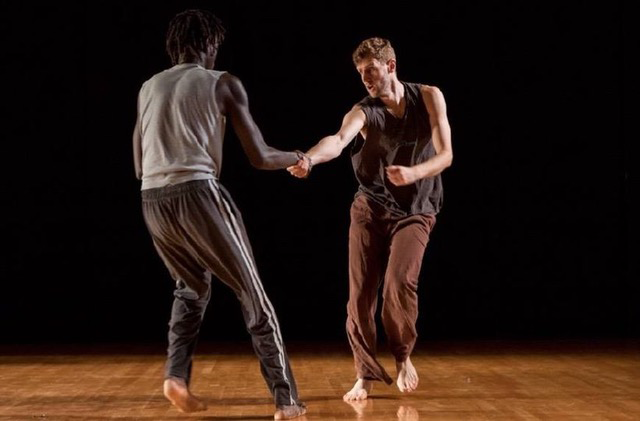
My movement research examines the intersection of ecological relationity, space, materiality, and embodied movement through structured expressive practice in order to better understand human–environment and human–nonhuman interactions. To accomplish this, I employ embodied movement investigations, which include solo and group movement scores, improvisation, dance performance, and participatory observation of social movements related to wetland ecosystems, particulary in urban corridors of the U.S. and Mexico. Quotidian considerations around sensory and locomotive access, balance, perceptions of danger and safety, discomfort aversion, institutional and state intervention, and ethics fold into analyses of ecological relation and the spatialized interactions of beings, objects, and materials to produce interpretive artifacts in the form of dance performances and durational practices which document these various wetland areas.
This research builds on the work of professor, choreographer, and dancer Jennifer Monson to argue that sensorial, movement-based experience is a vital investigative methdology and is, indeed, foundational to our experience of ecology and space. This approach grounds itself in two concepts: first, structured, movement-based practice and performance cultivate and integrate sensorial awareness with ecological phenomena to generate meaningful insights that are expressible in and interpretable through cultural artifacts, such as digital recordings, performance, movement scores, and the like; and, second, embodied sensorial experience, as an undertheorized and underutilized archival process of ecological knowledge production, is capable of generating ecological insights that other investigative frameworks might overlook. The body as it moves through space serves as something of a ruler and a pipette, in a sense, of the ecological systems in which it is embedded through its role in measuring distances, volumes, and dimensionalities, assessing surfaces and locomotive pathways, and taking in, giving out, and otherwise exchanging beings (e.g., microbes and seeds), materials (e.g., sediment and sweat), and substances (e.g., water vapor, oxygen, methane, and carbon dioxide).
Performance-based movement research aids in constructing meaningful and sometimes altogether new understandings of ecological systems and their constituent beings, objects, and materials. Together these insights complicate the perceived boundedness of self and environment in a way that strongly supports claims that all being is interimbricated and irreducibly multiple.
Dance, Materiality, & Postcolonial Ecologies
The materiality, structure, and liveliness of the particular outdoor spaces where I dance deeply inform my approach to movement research as I and the dancers that I collaborate with negotiate with the terrains, materials, objects, and other living beings — flora, fauna, fungi, et al. — that inhabit these areas in order to strengthen communities of shared meaning and collaborative existence, understanding that we are collectively constituted and sustained by the complex interactions of multiple living and nonliving systems. This approach first expressed its most apparent influence in my work "Myth Fail" (2009), which emerged from an extended investigation of the ecologically sensitive Tijuana River Estuary which straddles the political border between California and Baja California where the Pacific Ocean, Mexico, and the U.S. meet within the militarized and transnational San Diego–Tijuana urban corridor. After another four years of embodied engagement with this intertidal coastal wetland, which included three different movement frameworks (namely cross-border solidarity demonstrations, beach clean-ups, and dance improvisation), I performed and recorded a second work, "Beautiful Place" (2013), at the same location.
This multi-year, movement-based research produced experiential and documentary evidence of the intricate multi-species intimacies and complex being–object–material interactions of a rare coastal wetlands ecosystem situated on the periphery of a major urban zone. This research points toward the myriad ways in which space, race, gender, colonialism, militarization, urbanization, questions of access, and territorialized practices of meaning production are deeply imbricated in the biological diversity, history, and material present of the Tijuana River watershed. The goal of this research is to develop an artistic practice that "speak[s] to the soul", to use the words of bardic mythologist Martin Shaw, to activate, disseminate, and further collective counter-practices to transnational colonial legacies of environmental violence with its myriad and disproportionate impacts along gendered and racialized lines.
This work was foundational to my later archival investigations of ecologies of megacities as my research pivoted toward looking at the socioecology of global hip hop, specifically dance practices under the hip hop umbrella, as a grassroots, artistically oriented, youth-led social movement in cities like Tehran, New York, and Los Angeles. In these cities, embodied experiences of dense urbanity in the context of inconsistent state presence and often arbitrary intervention has led subaltern youth to recontextualize global hip hop practices in locally-relevant idioms of movement-based expression.
Endnotes
- 1 See Ted Swedenburg, "Hip-Hop of the Revolution (The Sharif Don't Like It)", Middle East Report Online, January 5, 2012, https://merip.org/2012/01/hip-hop-of-the-revolution/ (accessed March 27, 2025). See also Sean "Ulysses" O'Keefe, "Hip Hop and the Arab Uprisings", openDemocracy, February 24, 2012, https://www.opendemocracy.net/ulysses/hip-hop-and-arab-uprisings (accessed June 27, 2016). O'Keefe states in part that "western observers tend to overestimate Arabic hip-hop's role in the uprisings", and also noting that "Egyptian rappers Arabian Knightz and Deeb regularly complain that western media supports and promotes Arabic hip-hop far more than the Arabic media does (although western media's reasons are not always honourable).".
Papers & Presentations
Quiet Commotion: Street Dance, Hip Hop, and Social Change in Tehran
Around the globe predominantly poor, excluded, and urban youth are changing cities through hip hop and pushing back against the authority of the state or filling its void with their own visions of culture, collective association, autonomy, and moral order. Using the lens of urban sociology, this paper examines hip hop dance and MCing/rap in Tehran and traces how Iranian youth, through their everyday expressive practices, organized themselves into a zirzamin-e hip hop ("hip hop underground") in the 2000s. This youth-driven grassroots movement made use of the symbolism and material of the city to pursue fun and a sense of collectivity through shared identity. I apply Tricia Rose's insights about symbolic appropriation of space through hip hop (1994) to Asef Bayat's discussion of the "quiet encroachment" of everyday Iranians have engaged in street politics in their assertions of collective presence. By looking at how these youth present, perform, describe, and share their homegrown version of hip hop, this paper argues that Iranian youth have been engaged in a similar kind of street politics in their pursuit of fun and have won—in fits and starts—real gains for themselves.
Hyperrhythms: Ecological Rhythms and Dance Without Nature
This paper places theorist, dancer, and choreographer Rudolf von Laban's racism in the context of his spatial theories and his youthful experiences of the Austro-Hungarian military presence in Bosnia and Herzegovina to argue alongside writers like Dina Gilio-Whitaker and Kathryn Yusoff that race is foundational to Western concepts of space as an openness available to white consumptive practices of occupation and terraforming. This is paired with the formulation of the concept of hyperrhythms, which—building on Timothy Morton's hyperobjects—are oscillating natural processes massively distributed in time relative to terrestrial lifespans. Hyperrhythms, I argue, enmesh terrestrial life in massive cosmic, climatic, and geological system functions that, while difficult to perceive, nonetheless make all sociocultural operations fundamentally ecological. This then informs a critique of the eurocentric Society/Nature binary and anthropocentric notions of "harmony" with Nature to argue that expressive practices like dance can help activate ecological attunement and move us beyond the Society/Nature divide.
Book Reviews
How to Rap: The Art and Science of the Hip-Hop MC (2009)
An abundantly useful text on how hip hop MCs approach writing, making, and performing rap, author Paul Edwards covers issues related to content selection, rhythmic structure, writing, and performance strategies.
Read the full book review.
Street Politics: Poor People's Movements in Iran (1997)
In this crucial work, Asef Bayat argues that Iran's urban poor, being structurally disempowered and simultaneously caught in a constant struggle in, about, and for urban space, exert their social power in ordinary, surreptitious, unassuming ways in order to secure their own survival. This type of everyday direct action is termed "quiet encroachment" ....
Read the full book review.
A Life for Dance ([1935] 1975)
Rudolf Laban's well cited but still highly underanalyzed autobiography, A Life for Dance, offers a crucial opportunity for contemporary audiences to understand the philosophical underpinnings and sociohistorical context of ausdruckstanz, or "dance of expression"—what we would now call modern dance—, through the eyes of Hungarian dancer, choreographer, and movement theorist Rudolf Laban. Alternating between dance history, life story, and racist ethnographical study ....
Read the full book review.
The Mastery of Movement (4th ed., 2011)
In the mid-twentieth century, Rudolf von Laban famously pioneered a kinetographic notation system known as Labanotation, which had as its aim the encoding of human motion in writing for the purposes of reproducing movement-based works of performance art and for preservation in the historical record. Notwithstanding recent monographs which have examined more critically Laban's collaboration with the Nazi regime in mid-twentieth century Germany, more critical analysis remains to be brought to bear on the racism in works like Mastery.
Read the full book review.
The Makers of Modern Dance in Germany (2003)
Of the wife and husband pair who wrote Makers, Isa Partsch-Bergsohn studied under Mary Wigman and Kurt Jooss and lived through some of the events covered in this brief history of early- to mid-twentieth century Germany. While Partsch-Bergsohn does include some insightful, autobiographical mini-essays or reflections about her experiences working with Kurt Jooss and Mary Wigman, which are in their own right valuable autobiographical historical accounts, what emerges over the course of the text is a fraught blurring between rigorous historical scholarship and the subjective experience as a participant in the history. The book's approach to history writing is an anachronism ....
Read the full book review.